If you are like me, your knowledge of the Old Testament has a foundation of stories told during elementary church programs. Many of these stories were visualized by flannelgraph characters displayed on a flannel board. But when you continue to study the Scriptures, you will […]
On the 18th of July, AD64, fire broke out in the great city of Rome. The exact location of the beginning sparks of the fire and the cause of the burning of Rome remain unknown. Speculation continues the fire began either in the city’s marketplace or in the more poorly constructed slums of city. Fanned by the winds of summer, flames spread quickly through the dry, wooden structures of the city of the Caesar.
Rome in Flames
The fire seemed to take on a life of its own. For seven nights and six days, the fire meandered through the city, veraciously devouring everything in its path. When the combustion had finally run its course, more than 70% of the city lie in an ashen state of ruin. Ten of the city’s fourteen districts were completely raised to the ground. Hundreds of people died in the fire; tens of thousands left homeless.
It had its beginning in that part of the circus which adjoins the Palatine and Caelian hills, where, amid the shops containing inflammable wares, the conflagration both broke out and instantly became so fierce and so rapid from the wind that it seized in its grasp the entire length of the circus.
Tacitus, Roman historian
Rumors and Reactions
[content_block id=13382]
While the blaze was still burning, people demanded an explanation. Rumors soon spread that Nero ordered the torching of the city, desiring his own new palace and gardens. Many were telling the tale that while the city was in flames, Nero was on a private stage, strumming a citara (lyre) and singing of the destruction of Troy. Most modern historians do not blame Nero for the burning of Rome. Italy’s capitol was a city of more than a million people. Many homes were wooden or make-shift constructions. A fire in one home could engulf the entire block within moments.
Nero’s Response to Burning of Rome
When the fire broke out, Nero was at his summer palace in Antium, a setting which provided a much cooler night’s sleep. He returned to the city immediately and found the fire approaching his own mansion. He ran about the city the first night without his personal guards directing efforts to quell the spread of the angry flames. For the relief of the homeless, he threw open the Field of Mars, Agrippa’s public buildings, and his own gardens for people to live. Food was brought in from neighboring cities and either given away or dropped in cost to a quarter of its value. While Nero was an evil, uncaring man, he appeared to do what he could to respond to the city’s worst disaster.
But remember the earlier times! When you were first enlightened, you went through great struggles and suffering. 33 Sometimes you were exposed to public reproach and physical abuse. Sometimes you stood alongside people who were being treated in that way. 34 You even shared the sufferings of those who were imprisoned. When people looted your property, you actually welcomed it joyfully, because you knew that you had a better possession, a lasting one.
Hebrews 10:32-34 NASB
Hebrews 10:32-34 NCV
Hebrews 10:32-34 NKJV
Hebrews 10:32-34 ESV
Hebrews 10:32-34 NIV
Hebrews 10:32-34 NLT
Hebrews 10:32-34 MESSAGE
Hebrews 10:32-34 HCSB
Terror and a Scapegoat
National Geographic : Rome in Flames
Imagine for a moment the terror within the city. With no idea of where to go or what to do, people crowded into the streets andcountry roads or lay in the fields. Some who had lost everything preferred to die even though they could have escaped. Others chose to die because they had lost their loved ones. No one dared fight the flames. Attempts to do so were prevented by menacing, pillaging groups. Some even added to the flames, throwing in their own torches claiming they were under orders to do so.
Nero immediately began to search for a scapegoat. The Emperor found one in Christians, a rather new and obscure religious splinter of the Jewish faith. There was a small following of Christians in the city but their numbers were much smaller than most religions. To appease the masses, Nero had some victims fed to the lions during great public spectacles in the colosseum. To others, he set them on fire so they would understand the depth of their crime. Interestingly, Nero never officially persecuted Christians nor did he condemn them for their faith. He punished them for the fire.
Conclusions
When the dust had settled, a massive rebuilding effort was begun. From the ashes of the fire rose a more brilliant, more spectacular Rome. Marble and stone replaced wood in the building of many structures. Narrow dirt roads were transformed into wider, stone paved roadways. Pedestrian arcades and ample supplies of water lined the streets, hoping to prevent future disasters. The debris from the fire was used to fill the malaria-plagued marsh land, solving one of the city’s longest-running health hazards.
As we bring our thoughts about the travels that Paul made after the close of the book of Acts, here are some points to ponder about the concepts of today’s lesson.
Nero seems to have used Christians as scapegoats to blame for the burning of Rome. Are Christians used as scapegoats for blame today?
How can you respond to persecution by re-affirming your commitment to Christ? How can you honor God through your response to persecution?
What did Jesus mean when He said He was sending us out like sheep among wolves (Matthew 10:16-33)? Does the principle still hold true today?
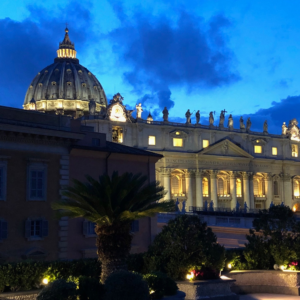
The Catholic Church began looking at the Vatican at the center of ecclesiastical theology with the construction of a basilica over the grave of the Apostle Peter in the 4th century A.D.
The book of Acts comes to an end with the Apostle Paul scheduled to have a court date with Caesar Nero himself sitting as judge. Paul awaits the arrival in Rome of his Jewish accusers. Luke provides us with these words:
Paul lived there for two whole years at his own expense, and welcomed everyone who came to see him. 31 He announced the kingdom of God, and taught the things about the Lord Jesus the Messiah, with all boldness, and with no one stopping him
(Acts 28:30-31 NT Everyone).
Acts 28:30-31 NASB
Acts 28:30-31 ESV
Acts 28:30-31 NCV
Acts 28:30-31 NKJV
Acts 28:30-31 NIV
Acts 28:30-31 NLT
Acts 28:30-31 MESSAGE
Acts 28:30-31 HCSB
Exercising his right as a Roman citizen, Paul demanded that he be permitted to be tried before Caesar. In a sense, he was appealing to the Supreme Court before a verdict in a lower court is released. It is hinted that had Paul not appealed to Caesar, he would have been released before the close of Acts.
The final chapters of Acts tell us of Paul’s trip to Rome. He accusers – the leadership of the Jews from Jerusalem – had two years to come to Rome and present their case against Paul. From what history and tradition provide us, Paul remained in Rome for two years under “house arrest.” It is doubtful whether the Jewish contingency bothered to make the trip to Rome.
For two years, the most dominant force in Christian evangelism sat under the watchful eyes of Roman guards. Why did God put Paul’s life on hold? What did he do during that time?
Why Wait?
The Bible develops several points that explain why it is necessary to wait for the timing and processes of the Lord. The concept seems important – the Open Bible lists 81 Bible verses that emphasize our need to wait upon the Lord. Let’s consider a few important passages.
Now, dear friends, do not let this one thing escape your notice, that a single day is like a thousand years with the Lord and a thousand years are like a single day. 9 The Lord is not slow concerning his promise, as some regard slowness, but is being patient toward you, because he does not wish for any to perish but for all to come to repentance (2 Peter 3:8-9 NET).
Reasons to Wait
One of the reasons we wait is because God does not count or measure time the way we do. We have a schedule to keep – God does not. God had Israel wander in the wilderness for 40 years – not to punish them for a lengthy amount of time, but for all of them to learn the lesson and the truth, which required the death of some.
But they who wait for the Lord shall renew their strength; they shall mount up with wings like eagles; they shall run and not be weary; they shall walk and not faint (Isaiah 40:31 ESV).
Another reason we wait is to allow time for our strength to be renewed. When we work hard physically, we need to rest and regain our strength so that we can work again. There are times when we work hard spiritually. But the hectic nature of our pace rarely allows us time to rest and regain spiritual strength. Sometimes God “puts us on pause” so that we can be renewed and prepared to soar.
Make me to know your ways, O Lord; teach me your paths. Lead me in your truth and teach me, for you are the God of my salvation; for you I wait all the day long (Psalms 25:4-5 ESV).
Sometimes we wait so that we can learn. The psalmist says he waits all day for the Lord to teach him godly ways and lead him along godly paths. If God is asking you to wait, your Bible had better be open.
Trust in him at all times, O people; pour out your heart before him; God is a refuge for us. Selah (Psalm 62:8 ESV).
Just as times of waiting should point us to the Scriptures, waiting for God should bring us to our knees in prayer. The psalmist encourages us to pour out our hearts to God. Waiting should strengthen and improve the time we spend with God in prayer. This verse deserves our attention to two more important details.
Waiting for God to Build Your Highway
During our times of waiting, we should see God as a refuge – a place of safety in the times of storms. Bask in the grace and power of God. Don’t plead with Him for things. Don’t ask Him to hurry His timetable. Thank Him for being your shelter and shield.
Finally, notice the last word of this verse. It is the word “Selah.” It is a Hebrew word that occurs 71 times in the Psalms and three times in the prophetic book of Habakkuk. Based on the context, most theologians believe it is a musical term and provides musical direction. The fact that it is found at the end of phrases, verses or chapters leads us to believe that it suggests a pause – a musical notation to “rest” if you will.
It is not easy to trace the etymology of this word. The word is spelled the same as the Hebrew verb סלה
(sala) which means to heap up. The word is mostly used about building highways. Highways come along when a heap of individuals trod the same route, creating a natural path. After a time, the government comes in and heaps up crushed stones upon the path, creating an official road or highway, making the journey easier and more directed for future travelers.
The command to create a highway for the Lord in the desert has little to do with Jeeps or Land Rovers. Instead, we are being asked to follow the same path, to be wiser and more efficient with the steps we take and the way we approach God. The concept is the same as the command to “lift up the Lord.” We are not to physically hoist Him up in our arms to the ceiling. Rather we should purposely place God into the highest priority of our lives.
A Musical Rest
In music, the people are not to “heap up” the volume of their voices and instruments but need to bring their musical tones into an amazing harmonious chord. A musician today might be instructed to resolve the chord as the musical expression comes to a pause.
Pour out your heart to God as you rest. Continue to rest, waiting for God to answer, strengthen, and direct you. Understand that you are waiting for God to heap stones upon the path He wants you to take. Bring the music of your life into perfect harmony with the Composer of all.
One final thought about waiting comes from Luke’s commentary at the end of Acts. He tells us that Paul was able to proclaim and teach about Jesus unhindered and with boldness. Perhaps God knew both what Paul needed – a time to not be chased from town to town by Jewish leaders – and a chance to talk about Jesus.
A Captive Audience
In the Roman world, spending time in prison was rarely a long-term punishment. People were rarely sentenced to sixty years in prison. Most prisoners were either awaiting trial or awaiting execution. Debtors could be imprisoned until their friends and family could pay off their debt (Matthew 18:30).
Conditions of imprisonment were linked to the status of the prisoner. Roman citizens were treated with respect. Non-Roman citizens – even those with political and financial clout – were often treated harshly. A Roman citizen awaiting trial was considered under house arrest. Though the prisoner and not the state paid for the accommodations – think of long-term renting of a motel room – this type of prisoner was typically treated under comfortable and favorable conditions. Discipline would have only been administered if the prisoner were behaving in a way that warranted a response.
The Roman citizen who made an appeal to Caesar for the trial was guarded by the Praetorian Guard. Caesar Augustus created nine permanent divisions of the guard in 27BC and stationed them around Rome. They were the most effective, resourceful, and dedicated soldiers in the Roman army. The Guard was abolished by Constantine in 312. There were close to 9000 soldiers in the Guard at this time in Paul’s life.
In his letter to the Philippians, Paul informs his brothers in Philippi that his Roman imprisonment – which one would think would hinder his ministry – actually resulted in the progress of the Gospel among the most unlikely of recipients.
Paul uses the word πραιτωρίῳ to describe the guard who guaranteed his safety and security in his house. Josephus tell us they would have been chained to the prisoner and they would have worked four hour shifts around the clock. Six men a day could not leave Paul’s side.
Paul tells the Philippians that the cause of Christ has become well-known throughout the entire Guard – and to everyone else.
Five Things You Probably Didn’t Know About the Praetorian Guard
They served as emergency firefighters.
They performed and patrolled the Roman games.
They played a significant role in assassinating several emperors.
They served as a secret police force, engaging in espionage, intimidation, arrests, and killings.
At least once, they auctioned off the emperorship to the highest bidder.
Writing to Important People
In addition to sharing Christ with some very important and influential people, Paul’s waiting time allowed him to write some very important churches. “The Prison Epistles” are four of Paul’s books that were penned during the two year span of his Roman imprisonment.
The books written at about the same time are Colossians, Philemon, Ephesians, and Philippians. Tychicus delivered Colossians (Colossians 4:7-9) and Ephesians (Ephesians 6:21). Onesimus accompanied Tychicus to Colossae (Colossians 4:9) and delivered the letter to Philemon (Philemon 10-17). The eight people that are mentioned in the four books are probably with Paul in Rome. They are Timothy, Luke, Aristarchus, Epaphras, Tychicus, Demas, Mark, and Jesus Justus. In all four books the content is similar, as is Paul’s condition (Colossians 1:24; Colossians 4:3; Ephesians 3:1, 13; Philemon 1, 9; Philippians 1:7, Philippians 2:17).
Time to be Thankful
One last positive outcome from Paul being forced to “wait” for two years in a Roman house prison. Paul was given time to pause and be thankful. His prison epistles underscore his grateful spirit.
We would expect a prisoner to say, “I am miserable!” Instead, Paul tells the Ephesians, “I am rich and blessed with more blessings than I can even count” (Ephesians 1:3).
We would expect a prisoner to say, “I am the most unhappy and disenchanted person in the world.” Rather, Paul tells the Philippians, “I can rejoice at all times and be content in whatever state I am in, even when I am in prison” (Philippians 4:4, 11).
Wouldn’t you imagine a prisoner to speak about their own personal needs? Paul tells the Colossians, “Christ is everything that I need” (Colossians 2:10).
We would expect a prisoner to put their faith on hold during the time in jail. Instead Paul preached the gospel to a runaway slave named Onesimus. That is the message of Philemon.
As we bring our thoughts about the time that Paul has to wait in Rome in a house prison, here are some points to ponder about the concepts of today’s lesson.
Do you ever feel “chained” to the circumstances or people in your life? What or who are those events or individuals? Could God be wanting to use you to “boldly and powerfully” witness about Christ in those circumstances?
What lessons have you learned during times in your life when God put your plans on hold and had you wait?
What can you do to express gratitude to others while you are called to wait?
[content_block id=13441]
The Gospel of Matthew was the most popular New Testament book of Early Christianity. It is the most quoted NT writing in other early Christian literature. It appears to be the text used in the largest number of early sermons. The book strives to connect the ministry of Jesus to the Jewish expectations of the coming Messiah through Old Testament Scriptures. No doubt its extensive presentation of the Sermon on the Mount added to this Gospel’s popularity.
It was natural for the early church to be fascinated with the Old Testament Scriptures that were fulfilled in Jesus. Matthew uses an abundance of references to the Old Testament. While many come from the Greek LXX, Matthew includes several that are from the Hebrew text, probably pointing us to his Judean readership.
Who Wrote the Book?
The external evidence testifies to the early existence and use of Matthew. The Didache is the first to clearly indicate this. “The Epistle of Barnabas,” Justin Martyr, and Eusebius, an early Christian historian, all quote from the gospel. Pantaneus found a Hebrew copy of Matthew in India, proposed to be Matthew’s destination.
The early church almost unanimously ascribed the gospel to the Apostle Matthew. Iranaeus, Polycarp, Clement of Rome, Clement of Alexandria, and Origen are just a few of the early church leaders who preserved this tradition.
Matthew was not one of the more outspoken of the apostles. Thiessen writes, “It would be strange to assign the Gospel to him if he did not write it.”
But you can see he was certainly fit for such a task. As a tax-collector he would have needed to know the local Aramaic form of Hebrew as well as been fluent in classical Greek. The task of collecting taxes would have made him a tremendous record keeper.
It was not until the liberal theology of the 1800s in Europe that the authorship to the apostle was questioned. For an understanding of the current liberal position, see the article on “The Synoptic Gospels.”
“Matthew composed the Logia in the Hebrew tongue; and each one interpreted them as he was able.”
PAPIAS
Church Father
To Whom Was Matthew Written?
The extensive use of the Old Testament coupled with its strong emphasis upon the Messiah and the Kingdom leads one to believe the readers were Jewish Christians in and around Palestine. Matthew’s roots were as a tax collector in and around Jerusalem which would give additional support to this theory.
When Was Matthew Written?
Attributing a certain date for the writing of this gospel greatly depends upon the understanding of the authorship of the book. If the author were the Apostle Matthew, a companion of Jesus, there would have been little reason or need to confer with other historical sources. The Apostle’s credibility as an eyewitness would have negated the need to copy from someone else. Coupled with such early attestation in other written sources, Matthew could well have been one of the earlier writings of the New Testament.
Given the meticulous nature of the record-keeping of a tax collector, Matthew may well have been written no more than a decade after the resurrection of Jesus, putting that gospel’s writing around 45AD. Papias writes about this gospel in his writings around 130AD and speaks of it in the past tense. Since Matthew does not mention the Fall of Jerusalem (70AD), we must conclude that the gospel was written before that tragedy. Thiessen concludes the Aramaic Matthew was written in 45AD and the Greek version in 50AD.
Modern theologians place a priority on the Gospel of Mark. This theory sees the writing coming from time Mark spent with Peter in Rome as Peter was facing his death. This account of Jesus’ life would then have to travel back to Palestine where some of Matthew’s followers copied from Mark and embellished their own version. This would have to place the dating sometime between 70AD and 125AD.
What Messages Resonate in Matthew?
We have already mentioned that the gospel of Matthew carries a very Jewish flavor, emphasizing the King and His Kingdom from Old Testament references. In addition, Matthew has these characteristics:
The first four chapters are chronological. Chapters 5 – 13 are topical while chapters 14 to 28 are chronological again.
The words “righteous” and “righteousness” occur more often in Matthew than the other three gospels combined.
The word “then” in the Greek occurs 90 times in Matthew while 6 times in Mark, 14 times in Luke and 10 times in John. Its frequency is probably due to Matthew thinking in Aramaic.
Matthew is the only gospel where the word “church” occurs.
Matthew has six great addresses of Jesus, including the Sermon on the Mount.
There are 15 parables in Matthew and 20 miracles.
Matthew shows an incredible interest in the Gentiles throughout the book.
Only Matthew tells of the sorrow and perhaps repentance of Judas.
What Do People Say About the Book?
In grandness of conception and in the power with which a mass of material is subordinated to great ideas no writing in either Testament, dealing with a historical theme, is to be compared with Matthew. In this respect the present writer would be at a loss to find its equal also in the other literature of antiquity.”—Zahn.
The captions κατὰ Μαθθαῖον, κατὰ Μάρκον, etc., are traced back from the oldest of our manuscripts, the Vaticanus, 1209, (B), to Irenæus in 185, and to the earliest collections of apostolic writings in the incipient formation of a New Testament canon.
— R. C. H. Lenski
In the last resort, we engage in evangelism today not because we want to or because we choose to or because we like to, but because we have been told to go, to preach, to make disciples, and that is enough for us.
— John R.W. Stott
KBS Homepage is undergoing a major revision. It will be available again soon.
The letter of 1 Corinthians to the members of the church at Corinth gives us one of the best pictures from either the New Testament or other records of history of how Christianity attempted to relate to an unChristian culture. Many commentaries emphasize the presence of problems in the church at Corinth. A more reasonable explanation sees the letter focusing on the decisions to live faithfully in an environment hostile to faith.
In many ways the church at Corinth struggled in the same way the church struggles today. Does a person of faith drink, smoke, or go out to piano bars late at night? What words provide a proper perspective on the LGBTQ+ issues? How can a Christian speak the truth without alienating everyone around him?
Who Wrote the Book?
The external evidence for the authorship of 1 Corinthians by the Apostle Paul is strong and continuous. Clement of Rome in the first century speaks of this epistle as “the epistle of the blessed Apostle Paul.” Ignatius, Polycarp, Justin Martyr, The Didache, and almost every other early source acknowledge the authorship of Paul
The internal evidence is just as strong. The writer calls himself Paul several times. The book easily dove-tails with the events of Paul’s life as recorded in the book of Acts. The affirmation that the resurrection had been seen by 500 witnesses many of whom were still alive would have been a statement in poor taste if the book were written later by someone other than Paul.
To Whom Was the Book Written?
The story of the beginning of the church at Corinth comprises Luke’s story as recorded in Acts 18:1-18. Paul came to Corinth from Athens. He made his home with Aquila and Priscilla who had come there from Rome. They were also tent makers do the three of them worked to help support Paul. Paul spent about 18 months there before appearing in front of Gallio for trial. Soldiers released Paul and the apostle set sail for Syria to close the second journey.
When Was the 1 Corinthians Written?
The book does present some challenges. In this epistle, Paul uses a phrase that refers to a former letter (1 Corinthians 5:9). Either Paul was talking about something that he wrote earlier in this letter or there were a separate letter written that we do not possess.
Paul himself explains the letter originated from Ephesus (1 Corinthians 16:8-9). Paul had a 2 year ministry in Ephesus. Time pushes the writing toward the end of that stay. We would date the writing of 1 Corinthians sometime in the spring of AD 54 or 55.
What Messages Resonate in the Book?
The apostle’s purpose seems to be clear from the contents of the epistle. His themes develop concerning:
The rebuke of a divisive or party spirit
The problems of sexual morality
Understanding and application of teaching about food sacrificed to idols
The correct teaching about concepts in public worship
The doctrine of the resurrection of the dead
Practical concerns of Paul for folks in Corinth
What Do People Say About 1 Corinthians?
Many leading Bible teachers make strong statements about the book of 1 Corinthians. Here are a few of their comments:
The gospel of the crucified Messiah must transform not only our beliefs but our behavior.
First Corinthians contains a frank discussion of the church and the issues that impacted real people in the first century. The Corinthian church was corroded with sin on a variety of fronts, so Paul provided an important model for how the church should handle the problem of sin in its midst. Rather than turn a blind eye toward relational division and all kinds of immorality, he addressed the problems head on. In his bold call to purity within the Corinthian church, Paul made it clear that he was willing to risk the good opinion of some in order to help cleanse the sin that tainted the church.
Chuck Swindoll
The resurrection of Jesus was like a boulder crashing into the pool of history.
Karl Barth
The same power that brought Christ back from the dead is operative within those who are Christ’s. The resurrection is an ongoing thing.
Leon Morris
1 Corinthians 13 is the Mount Everest of love writings.
Max Lucado
If Christ is not raised … he’s a counterfeit god too. You’re still in your sin, not secure in the prodigal grace of a loving Father. There’s no hope for justice, and your work may as well be pointless because we’re all heading for oblivion anyway. If Christ is not raised, Christianity is not intellectually credible or existentially satisfying.
Tim Keller
The Jericho Road is about an eighteen-mile path that connects Jerusalem to Jericho. The road drops 3600 feet in the short span of less than a mile. It is a steep, winding, descending, remote road that for centuries has been a haven for robbery and suffering. Evil lurks along every inch of this path. It became a symbol of suffering in the world and in everyday life.
The Jericho Road is about an eighteen-mile path that connects Jerusalem to Jericho. The road drops 3600 feet in the short span of less than a mile. It is a steep, winding, descending, remote road that for centuries has been a haven for robbery and suffering. Evil lurks along every inch of this path. It became a symbol of suffering in the world and in everyday life.
The Jericho Road in Scriptures
Numbers 26:3
Joshua 2:1
Joshua 6:1-27
Joshua 18:21
Numbers 22:1
1 Kings 16:34
Nehemiah 7:36
Ezra 2:34
2 Kings 2:4
2 Samuel 10:5
Matthew 20:29
Mark 10:46-52
Luke 19:1-9
Luke 10:25-37
Hebrews 11:30
John 11:18
Focus Scripture
“A man was going down from Jerusalem to Jericho.”
Luke 10:30a NIV
The Jericho Road in Bible Times
Travelers, merchants, pilgrims, soldiers have wandered its steps, as would any devout Jew who wished to stay clear of Samaritan soil. Even today the road between the two cities is infested with robbers who hide in the rocks and caverns of the area. Modern Jericho and its region are inhabited by only a few hundred miserable lives.
The area is dry and barren. While Jerusalem receives about 20 inches of rain a year, Jericho collects only about 8 inches. The town is an oasis growing in the middle of a desert. Its source of water is a spring known as Elisha’s Spring.
We sing about the Jericho Road, noting that its winding path only provides room for two – Jesus and you. Jesus taught Zaccheus there, along with healing a blind man. But He traveled the road several times each year, heading to Jerusalem for a handful of feasts. Its path is featured in Jesus’ story of the Good Samaritan.