Mediterranean Moments

The first stop on Paul’s second journey is the village of Lystra. Our Mediterranean Moments at Lystra focus on a market village situated in a pleasant valley, bordered by gently sloping hills through which two small but steady streams meandered their way to the open Lycaonian plain a few miles farther east.  The city resided on a small hill in the middle of the valley at the intersection of the streams.  Paul evangelized the village on his first missionary journey (Acts 14:8-21); revisited it on his second (16:1) and probably his third (18:23) excursions.

History of the Village of Lystra

Little is known of the early history of Lystra.  The name is apparently from the Lycaonian language as there are several bergs with derivatives of the name in the region.  Since Lystra did not lie along the course of the main roads, it was not destined to become a great city.  As a result, it was able to preserve more of its primitive, local character when Hellenism flavored the region.


Despite these drawbacks, or perhaps because of them, Augustus designated Lystra, along with Antioch of Psidia, a Roman colony in AD 6. Roman rule demanded a safe passage way connect the two cities.  Rome ruled Lystra for some time previously, following the reign of the Seleucids and Attalids. Augustus’ generals regarded Lystra as a suitable place for the Roman garrison charged to defend the province of Galatia from the mountain tribes.


Lystra was probably not significant enough to have been on Paul’s original itinerary during the first journey.  Paul and Barnabas were driven there from Iconium by hostile opponents. Thus Lystra became a relatively unimportant city of refuge, as did Berea later when Paul and Silas fled the wrath of the Thessalonians (Acts 17:10).


Luke identifies Lystra along with Derbe as cities of Lycaonia (in contrast to Iconium).  Lycaonia was a region or “state” in a broader region known as Galatia. In turn, Galatia occupied an even broader region known as Asia Minor. References in the area become a little confusing, as “Galatia” was also the designation of a smaller “state” like Lyconia. (Compare that to our “New York City, New York” concept.)  These cities of southern Galatia were most likely the recipients of the epistle to the Galatians.

Mission and Mentoring in Mediterranean Moments at Lystra

Converts made at Lystra during the first journey fulfilled Paul’s mission. Soon, though, many allowed themselves to be carried away by efforts from Jews in the area seeking Paul’s death.  Although Lystra was a Roman colony, the account contains no hint of Roman order or justice.  At the end of his career, Paul referred to the persecution that he experienced in Lystra (2 Tim 3:11). Earlier he explicitly recalls a stoning attempt (2 Cor 11:25).  It is probable that he alluded to this life event in the Galatian letter when he poignantly proclaims that “I bear on my body the marks of Jesus” (Gal 6:17).


Mediterranean moments at Lystra remind us of the setting in which Paul started his mission and his mentoring.

After gathering Silas and probably an entourage of a dozen believers for the journey, Paul leaves with his group across land from Antioch in Syria to the Galatian region of Derbe and Lystra. The conflict between Paul and Barnabas caused them to separate, but it did not seem to cause a division either between the two or toward the progress of the gospel message. Although the journey revisits cities from the first journey, the second journey tours through new lands, new adventures and new challenges.

Lystra was a Roman colony, serving mostly as a market town, both in Paul’s day and in current Turkey. Most likely, there was not a strong Jewish presence in the village. Our stop in this city, brings several discussion points and lessons to apply to our study.

The Pointe at Lystra

From The Pointe at Lystra, let’s pause to consider these ideas:

  • Paul develops a close mentoring relationship with his traveling companions. Most notably, we read and see the impact that the Apostle has on the lives of Silas and Timothy at this stop. For thought and consideration, what provisions are in place for people to develop that kind of relationship within your congregation? Who are you mentoring purposely to pass on both your understanding of Scripture (sound doctrine) and your commitment to serving and ministry? Who mentored you?
  • From our understanding of Scripture, Paul circumcised Timothy in order to take away a stumbling block that the youth would have in ministry and preaching to a Jewish population. As Paul had written to the Corinthians, it is an example of “becoming a Jew” in order to win converts from within Judaism (1 Corinthians 9:19). What freedoms are you setting aside in order to better reach the lost?
  • On the first journey, the people of Lystra witnessed a miracle performed through the hands of Paul. They immediately thought the pair of missionaries were gods sent from above. The people wanted to offer sacrifices and worship the duo (Acts 14:8-13). It is easy for leaders, especially the preacher, to be placed upon a pedestal. How did Paul and Barnabas respond (Acts 14:14-18)? Can this kind of dependence be found in your congregation? What safeguards are in place to prevent it from happening? Can the dangers of pride affect us all?
  • The disagreement which occurred between Paul and Barnabas before this journey could have caused the first division in the church. Conflict – especially unresolved conflict – is a challenge wherever it occurs. Are there people in your life with whom you have unresolved conflict? What assistance can passages like Jesus’ teaching in Matthew 5:23-25 and Matthew 18:15-17 provide? Does Paul’s words to the Ephesians (Ephesians 4:32) help?
Lesson Series This Lesson: Lystra This Lesson: Mediterranean Moments
KBS_2105_Grab_Your_Passport Lystra Mediterranean Moments


Lystra

“The City of Lystra” from the lesson series Grab Your Passport, April 2021

our Scripture

Paul also came to Derbe and to Lystra.

Acts 16:1-5 ESV
Acts 16:1-5 NASB Acts 16:1-5 NIV Acts 16:1-5 NLT Acts 16:1-5 MESSAGE


Other Scriptural References:

Acts 14:6-18

2 Timothy 3:10-11

Lystra was a mildly important city in the first century, though it was somewhat of a rustic, market town. Lystra is the city’s ancient Greek name. Today it is the village called Kilistra, also called Zoldera. It was located in a relatively backward region of Lycaonia, located today in south-central Turkey. In New Testament times, it was bordered on the west by Phrygia, on the north by Galatia, toward the east by Cappadocia and by Taurus on the south. The most important city in the area, both then and now, was the city of Iconium (which is Konya today).

Lystra was founded in 26BC by Augustus to be a colony for his retired army veterans. In Paul’s day, the colony had such Italian roots they used and spoke Latin rather than Greek. Some of the Italian cults became celebrated along with those of native gods and goddesses.

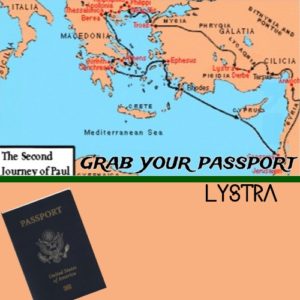
Lystra is located on a road that the Apostle Paul had no doubt traveled many times, even as a youth. The path stretched from Ephesus to Sardis to Antioch of Psidia to Iconium and Lystra, to Derbe, through the Cilician Gates, to Tarsus (Paul’s hometown), to Antioch in Syria where the road divided to go east or south.

Paul’s Journeys

The second missionary journey is underway, and each of Paul’s recorded journeys is longer than the one before. His first trip was about 1580 miles long. This journey will be about 3000 miles. The final and longest journey travels about 3300 miles.


In the first journey, Paul leaves Antioch in Syria by boat, but this time he travels on foot. Traveling on foot, Paul would have first come to Tarsus then to Derbe before making his way to Lystra. Luke does not mention a synagogue in Lystra, which probably means there were less than ten Jewish families in the city. There would have been a temple to Zeus in the city, probably near the city’s gates. A statue of Hermes (Mercury) has been found in excavations there. Greek mythological stories have Hermes visiting the city.


Interestingly, on the first journey, Paul healed a lame man in the city. The people believed that the gods had come down to visit them, calling Barnabas “Zeus” and calling Paul “Hermes” because he was the chief speaker (Acts 14:8-18).

Paul Develops Leaders in Lystra

The characters traveling with Paul changes on the second journey. Barnabas has taken John Mark and chooses to set sail toward the island of Cyprus. The paths of Barnabas and Paul do not cross again in the book of Acts. Barnabas may well have either stayed on Cyprus or continued south. evidence shows a strong Christian presence and tradition in Alexandria, Egypt.

Silas

Instead Paul chooses to take Silas, who is also known as Silvanus. Silas first appears as one of the leaders in Jerusalem during the time of the council concerning the admission of Gentiles into the church (Acts 15:22). His name indicates he was a Hellenistic Jew and probably comes from a stem meaning “wood.” He appears to have been a Roman citizen (Acts 16:37). After the council in Jerusalem, Silas was one of the leaders who accompanied Paul and Barnabas to Antioch to share the letter and their encouragement (Acts 15:22-32).


He was a good choice for Paul to take on the second journey because they were first heading into the hot-bed of Judaizers through the Galatian region. Silas would have been able to verify Paul’s leadership and message to the Jews in the area. Therefore his presence may have kept the persecution and turmoil to its minimum.

Timothy

It is at Lystra that Paul adds Timothy to his companions for the journey. Paul certainly served as a mentor to both Silas and Timothy, but the relationship with Timothy appears to be even deeper. Paul speaks of their connection as that to a father and son (1 Timothy 1:2). The chances are strong that Paul helped lead Timothy to Christ on his first journey (Acts 14:6), but in the absence of any allusion to Timothy’s father in the New Testament (both his mother and grandmother are mentioned by name – 2 Timothy 1:5), Paul may have stepped into that significant role as the young man matured.


Timothy was often left behind or sent ahead on the journey to help strengthen new believers or pave the way for the coming evangelistic message. Tradition has Timothy playing a significant role at the church in Ephesus. Timothy became one of Paul’s constant companions up until the point of the Apostle’s death.


Lesson Series This Lesson: The Pointe This Lesson: Mediterranean Moments
KBS_2105_Grab_Your_Passport
You Asked for It

A brother recently sent a text message and asked, “What are the qualifications for an elder?”

What are the qualifications for an elder in the church?

Let’s spend some time thinking about the answer because you asked for it.

The term “elder” has been used through many centuries and by many cultures. An elder exercised leadership by virtue of their position in the family, their age and experience, their personality, their skills and abilities, their stature, or their influence. An elder achieved such leadership by appointment, ordination or by the acquiescence of others. In most settings, the leadership also involved making judicial decisions for the family, tribe or nation.

The New Testament seems to use several terms to describe the leader in the church, though each label speaks to the person he is and the work he does. Each of these words seem to be equivalent in describing the same person. The elder speaks of the dignity and integrity of the person. The overseer provides a picture of the function and duty of the position. Finally the shepherd or pastor focuses on the shepherding and feeding of the flock.

As a side note, the use of pastor today as shifted to describe the function of the paid professional that preaches and leads in the church. In the New Testament, the pastor and the evangelist did not always describe the same person, though there may have been times when one person filled both roles.

The New Testament provides the picture of a truth for believers and congregations today: All of the churches had elders. Briefly skimming through the book of Acts, we find that there were elders in all the churches that Paul founded on the first missionary journey (Acts 14:23). There were elders at the church in Jerusalem (Acts 15:2). There were elders at the church in Ephesus (Acts 20:17). There were elders in all of the churches in the cities of Crete (Titus 1:5), throughout the Dispersion of the Roman Empire (James 1:1; 5:14), and elders in all of the churches in Pontus, Galatia, Cappadocia, Asia and Bithynia (1 Peter 1:1; 5:1).

Just as a matter of historical context, don’t picture a congregation on every street corner in a city, representing different denominations. There were no church buildings until over three hundred years later. Paul admonished early groups of believers that we don’t go around saying “I am of Peter” or “I am of Paul.”

Paul writes to two of his “students” about selecting elders, Titus and Timothy. He describes the character of the individual, as well as mentioning areas of life where you can observe leadership in action – the marriage and family, business and the community. Let’s look at the two passages of Scripture in the New International Version of the Bible. We can observe them together for an overall understanding. Then we will go back through and look at each individual characteristic.

1 Timothy 3:1-7

Here is a trustworthy saying: Whoever aspires to be an overseer desires a noble task. Now the overseer is to be above reproach, faithful to his wife, temperate, self-controlled, respectable, hospitable, able to teach, not given to drunkenness, not violent but gentle, not quarrelsome, not a lover of money. He must manage his own family well and see that his children obey him, and he must do so in a manner worthy of full respect. (If anyone does not know how to manage his own family, how can he take care of God’s church?) He must not be a recent convert, or he may become conceited and fall under the same judgment as the devil. He must also have a good reputation with outsiders, so that he will not fall into disgrace and into the devil’s trap.

Titus 1:6-9

An elder must be blameless, faithful to his wife, a man whose children believe and are not open to the charge of being wild and disobedient. Since an overseer manages God’s household, he must be blameless—not overbearing, not quick-tempered, not given to drunkenness, not violent, not pursuing dishonest gain. Rather, he must be hospitable, one who loves what is good, who is self-controlled, upright, holy and disciplined. He must hold firmly to the trustworthy message as it has been taught, so that he can encourage others by sound doctrine and refute those who oppose it.

Some churches and theologians see the two lists as a check-list for the position of elder. If someone is weaker in one of the areas, or if they lack in an area, they are disqualified for the position. That approach feels rather legalistic and ungracious. Instead see the list as places to look for examples of leadership. No one will be perfect, but certain characteristics and skills will come to the front.

Think of it like this. If a soccer team needs a goalie, you know there are certain skills and mindsets that make-up a quality goal keeper. The candidate may have several strengths, and some areas that are a little weaker and need help and work. You select the best person available to help the team.

1 Timothy TItus Explanation
1 Tim 3:1 aspires to be an overseer The role of an elder is one that is desired. This is not a position that should be filled through pressure or coercion which would result in half-hearted service.
1 Tim 3:2 above reproach Titus 1:6, 7 above reproach Not a perfect, but life lived in a way that others have no reason to think badly of the church or the Lord.
1 Tim 3:2 faithful to his wife Titus 1:6 faithful to his wife Remember that marriage is a picture of the relationship between Christ and the church. The image to be portrayed is faithfulness.
1 Tim 3:2 temperate Titus 1:8 disciplined All three of these speak to the same issue – disciple and control. We see it in drunkenness, but it is visible in so many other places. Does this person have self-control and discipline in their life or are they running without direction?
1 Tim 3:3 not given to drunkenness Titus 1:7 not given to drunkenness
1 Tim 3:2 self-controlled Titus 1:8 self-controlled
1 Tim 3:2 respectable We often say that respect is earned. Do people think highly of this individual? What do others see that brings that feeling?
1 Tim 3:2 hospitable Titus 1:8 hospitable With no church buildings, early Christians met in homes. Allow others to come to the house to talk about the faith and to worship.
1 Tim 3:2 able to teach Titus 1:9 can encourage others and refute those who oppose the message The ability to teach and explain is a gift. Do not narrow your thoughts to in front of a Bible Study class, but think about the ability to encourage and instruct others with words and behavior. This believer must know the Scripture inside and out.
1 Tim 3:3 not violent Titus 1:7 not violent It is interesting that both lists use the same wording. Violence – abusing power – must have been common then, as it is today.
1 Tim 3:3 gentle This quality always reminds me of the leadership of Moses. Gentle does not mean weak, but goes along with not being violent. This person has emotions under control.
1 Tim 3:3 not quarrelsome Titus 1:7 not overbearing, not quick-tempered Does the person fly off the handle? Are they always argumentative? Must they always have their way?
1 Tim 3:3 not a lover of money Titus 1:7 not pursuing dishonest gain Loving money more than other things causes so many problems. You can see that attitude in someone’s life.
1 Tim 3:4-5 manages own family well Titus 1:6-7 man whose children believe One of the first places to look for leadership qualities is in the home. How can he help manage God’s household if he cannot manage his own? His family respects him. He has made an impact upon the lives of his children so they have an opportunity to believe. We cannot dictate the decisions and faith of our children, but we can provide a nurturing environment where faith can grow.
1 Tim 3:6 not a recent convert The idea of “not recent” is certainly subjective. This is a mature believer who is not likely to become proud or arrogant because of the position.
1 Tim 3:7 good reputation with outsiders People outside the church respect him for his integrity and behavior.
Titus 1 :8 lover of good This is a person who leans toward seeing that goodness is done – for others, for organizations.
Titus 1:8 upright This word speaks to justice and people being treated fairly.
Titus 1:8 holy For the Lord said, Be holy because I am holy. Understand how God works in your life to change and influence your behavior.


There are so many things that could be said about any or all of the items in these lists, we could continue discussing for days. I wanted to speak about two other issues.

For centuries the church has struggled with the meaning of the phrase “the husband of one wife.” Does this mean that a divorced and remarried person cannot be an elder? What about a one whose wife died? Does this mean that a woman should not be an elder? So much in this list has addressed the perception of others based upon behaviors and reputations. This is to be a faithful person – if there is a divorce, the eldership should be far enough removed that the people understand the circumstances. There is no doubt as to the current ability to be faithful.

Is gender a cultural thing or is this a biblical command for the elder to be male? The issue rests somewhere on the edge of a command and the understanding of the individual congregation. There are many Scriptures that speak to the role of men and women, both inside and outside the church. This question may need to be addressed in another presentation.

Finally, there is a precedent for selecting leaders which needs to be mentioned. Look for an elder who is already doing the job of an elder without the title. Are there people who are leading small groups of people, who have the heart of a shepherd? Is there someone who is active in sharing their faith? Are there those who consistently serve others through teaching and encouraging?

The church needs to recognize those who are already serving by publicly acknowledging their service, by ordaining them to give them authority and blessing.


Hope this helps.
You Asked for It

The wise among us spend our entire life asking questions. Your curiosity about uncertainties sparks your passion and spurs your desire to discover new truths. The road to the adventure of learning begins because you asked for it.

Where do you find meaning in life? When asked the question, many respond with, “I want to be happy.” Happiness is fleeting and the feeling is rarely sustainable. Life is rooted in discovering the answers to struggles and purpose. Those answers provide value and can be uncovered in the Bible.

But how do I understand the Bible? While the basic message of the Scriptures provides comfort and hope in a generally understandable way, finding answers to specific questions can be challenging. The Bible was written over hundreds of years into a culture that is foreign to ours today.

“Life is filled with unanswered questions, but it is the courage to seek those answers that continues to give meaning to life. You can spend your life wallowing in despair, wondering why you were the one who was led towards the road strewn with pain, or you can be grateful that you are strong enough to survive it.”

J.D. Stroube

Do you have a passage of Scripture that troubles you, or are you wondering what the Bible says about a specific subject? Submit your questions through the form below and I will strive to provide you with an answer from a biblical foundation because you asked for it.

In your question, be sure and mention the actual Scripture verse that you are wondering about if you have one in mind.

If you have a particular setting for the reason for your question, like you are leading a small group study and need ideas or an approach as a discussion question, let me know and I will attempt to address possible lesson ideas.

Name
Email
Subject
Message
Submit
The form has been submitted successfully!
There has been some error while submitting the form. Please verify all form fields again.

Past Columns from “You Asked for It”

grab your passport to antioch

“The City of Antioch” from the lesson series Grab Your Passport, April 2021

our Scripture

 Let us return and visit the brothers in every city where we proclaimed the Word of the Lord, and see how they are (Acts 15:36 ESV).

Acts 15:36-41 ESV
Acts 15:36-41 NASB
Acts 15:36-41 NIV
Acts 15:36-41 NLT
Acts 15:36-41 MESSAGE


Other Scriptural References:

Acts 16:1-40

Acts 17:1-34

Acts 18:1-22

First century Christians were drawn to cities. The city of Jerusalem for its Old Testament heritage and for the chance to walk in the footsteps of Jesus.  Tradition has it that many would meet annually in the upper room to celebrate the “Last Supper.” Antioch became one of the prominent cities outside of Judea to be touched by the message of the Gospel.

Jerusalem was a center for the history and heritage of the church. But there is no question that Antioch was the Faith’s center – for encouragement, teaching, leadership and outreach.  In fact, churches today might consider Antioch as a model for what the church ought to do and be in the culture around them.

Antioch was the capital of Syria during both the Seleucid reign and the Roman imperial rule. Antioch today is modern Antakya on the border of Turkey and Syria. The ancient city was located on the east side of the Orontes River. In some places of the city, the river was completely surrounding the city.

The location of Antioch was the main reason for its status in the world. The city was located at the intersection of the major trade routes connecting Egypt, Asia Minor, Greece, Italy, Mesopotamia, Armenia and India.

It was a significant spot for the spread of the Christian faith. Antioch allowed a strong presence of Judaism to co-exist with the mythologies of the Greco-Roman world, coupled with the religions of Africa and Asia. In addition, education and the arts were held in high esteem.


Like most cities today, Antioch was racially diverse and culturally pluralistic.  As a result, when the believers were scattered from Judea and arrived there (Acts 11:19-20), they had to wrestle with how to make the gospel meaningful for the diverse groups.  There appear to be at least four factors that helped account for their success.


1) They wanted to create an ethnic union within the church rather than adhere to the world’s answer of ethnic division.  To maintain “peace” the political leader of Antioch “walled” off the four dominant ethnic groups of its population – Greek, Syrian, African and Hebrew.  Today’s political unrest in the Middle East has deep roots.  But the gospel breaks down walls of separation and hostility (Eph 2:14-22) and brings diverse peoples together in Christ.

2) They soon had multi-ethnic leadership.  The church developed a strong leadership base, including pastors, teachers and evangelists who reflected the composition of the community.  Notice the cross-section of the city represented by the leadership team in Acts 13:

  • Barnabas, a Hellenist from Cyprus raised in a priestly family (Acts 4:36, 11:22-33)
  • Simeon (Niger), an African
  • Lucius of Cyrene, also of African descent
  • Manaen, childhood companion of Herod Antipas (Mark 6:17-28)
  • Saul (Paul), a Hellenistic Jew from Tarsus with rabbinical training and Roman citizenship (note how Barnabas intentionally recruited this young, untried leader (Acts 11:25-26)

3) They sent out ministry teams. Paul used Antioch as his base of operations for his three journeys (Acts 13:1-3; 15:36-41; and 18:22-23). Moreover, Antioch served as a crossroads for travelers from the Tigris and Euphrates River valleys to the east, Asia Minor to the north, and Egypt to the south.

4) They joined together to accomplish projects of compassion.  A famine in Judea became an opportunity for the Christians at Antioch to serve their Jewish brothers in Judea (Acts 11:27-30).


Lesson Series The Pointe Mediterranean Moments
KBS_2105_Grab_Your_Passport
Paul's second journey

“Paul’s Second Journey” from the lesson series Grab Your Passport, April 2021

our Scripture

 Let us return and visit the brothers in every city where we proclaimed the Word of the Lord, and see how they are (Acts 15:36 ESV).

Acts 15:36-41 ESV
Acts 15:36-41 NASB
Acts 15:36-41 NIV
Acts 15:36-41 NLT
Acts 15:36-41 MESSAGE


Other Scriptural References:

Acts 16:1-40

Acts 17:1-34

Acts 18:1-22

our Lesson

The mission of Paul’s second journey fits with a question many churches face today. How many of the new Christians in your congregation this year will persist until next year? Several organizations have conducted limited and local polls among new converts, but the results have been varied and inconsistent. Some surveys have found a persistence

[su_pullquote align=”right”]Charles E. Hackett, former national director for missions for the Assemblies of God in the U.S. said, “A soul at the altar does not generate much excitement in some circles because we realize approximately ninety-five out of every hundred will not become integrated into the church. In fact, most of them will not return for a second visit.”[/su_pullquote]

rate as high as 85%, while others cite stats that do not get out of single digits. The surveys rarely follow a structured method for data collection, and are not part of a scientific study. Many of the numbers appear to be based on anecdotal evidence. Given the myriad of divisions within the Church, and even disagreement about the definition of “falling away,” it is not feasible to ascertain conclusive answers or results.

How Do Christians Persist?

The Pew Research Center gives a more accurate view of the religious landscape in America. According to their research, Americans who describe themselves as Christians stands at about 65% in 2019. The number is down 12 percentage points from a decade ago. Both Protestants and Catholics are experiencing losses of the population share. Meanwhile, the number who identify as atheist, agnostic, or nothing in particular continues to grow at 26%.

Ed Stetzer, editor for Christianity Today and expert on church growth, writes about things mature believers can do to help keep people from falling away. “First, we can seek to understand why such people fall away. Second, we can discern and devise ways we can strengthen our discipleship environments to allow the full spectrum of seekers and strugglers have safe environments to belong, become and believe (and keep on believing).”

Paul’s Second Journey

When Paul wanted to return to visit believers from his first journey, his concern was for the persistence of the new converts to Christianity. Honestly, it is surprising that any Gentile church in the first century was able to endure. The resources upon which they were able to build were faulty and limited. New Christians were surrounded by a culture that was pagan and immoral. Few understood the teachings of this Rabbi from Nazareth. It was a time when Christianity was simply seen as a dissenting sect of the Jewish religion. These believers were subject to persecution from zealots of the Jewish faith to militants of the Roman Empire. Inside families, individuals were ostracized because they had abandoned the family faith.

Paul’s second journey found the Apostle returning to cities he had visited to see how the church and the people were surviving in such a hostile environment. Paul’s visit had an impact on the churches. Three phrases in three passages from Paul’s second journey provide threads of understanding of the Apostle’s methods and heart.

They Increased in Numbers Daily

When Paul and his companions traveled to the churches, they spent time with people and they proclaimed God’s Word as seen through the life of His Son. Luke connects this proclamation of the Word with “the churches were strengthened in the faith” (Acts 16:5). As a result, the church increased in numbers daily. The short phrase carries several implications. The growth happened outside and apart from a church building. There were no official church buildings until three hundred years later. The growth happened beyond the reach of the “professional” staff – the apostles and other church leadership. People shared their understanding of the good news of Jesus Christ to their friends, and their friends responded immediately.

God Had Called us to Preach the Gospel to Them

Luke includes vital details of the ministry of the Apostle  (Acts 16:6-10 NIV) that affirm an important principle. God is at work in achieving His purposes in the spread of the Gospel. Paul and his companions were sensitive and open to the leading of God’s Holy Spirit in their decisions and their journey. As they traveled through the regions of Phrygia and Galatia, they had been kept from entering Asia by the Holy Spirit (Acts 16:6). When they tried to enter Bithynia, the Spirit of Jesus would not allow them (Acts 16:7). They immediately departed for Macedonia after Paul had seen a vision (Acts 16:9-10). God wants to guide us; do we want to listen?

I See That in Every Way You Are Very Religious

When Paul would enter a new city or area, he would first connect with the people who had a religious or spiritual culture, even if the culture disagreed with the message of Christ. He would first go to the city’s synagogue and begin talking to the Jews who understood the longing for a Messiah. In his famous speech to the men of Athens (Acts 17:22-23), Paul commended them for being religious. He pointed them to their own altar offering reverence to “the unknown god.” Paul began speaking about the unknown God who could be known through His Son, Jesus the Messiah. He wanted the people listening to feel welcomed and connected, rather than antagonize them by ostracizing them.

Highlights of Paul’s Second Journey

Paul’s second journey featured some incredible highlights. A few of them include:

  • Paul befriended a young man named Timothy at one of the first stops. His mother and grandmothers were Jewish believers, but from what can be determined, his father was Greek. Timothy had a good reputation among the believers so Paul invited him to join them on the journey. Timothy would receive at least two letters written by Paul which are now a part of the New Testament. The young man would one day be left in Ephesus to lead the believers there. How important are mentors in understanding the doctrines of faith – and in living the faith out each day?
  • As Paul was traveling through the edge of the region of Mysia, near the town of Troas, Paul had a dream that a man from Macedonia (north of Greece) called to him to come to Macedonia and help them. Paul took this as a sign from the Holy Spirit to alter their plans. Immediately the left for Macedonia. Do you look for signs of God’s leading in your life? How do you know God is directing you?
  • On the way to Macedonia, they traveled to Philippi where they met a slave girl who had an evil spirit. Through the power of the spirit, she was able to foresee the future. The girl followed Paul around until finally he cast the demon out of her. The girl’s owners were not happy because their means of making money was gone. They incited a riot against Paul and Silas and had them thrown in prison. Can demons be active today? What are their purposes? How do we see their effects?
  • As Paul journeyed, he spent about a year and a half of this tour in the city of Corinth. To support himself and his companions, Paul used his skills as a tent-maker. What does this say about the importance of our faith in the workplace? How does faith affect what we do at work?

As we travel from city to city, we will learn lessons that will help us share the Gospel with an “unchurched” culture.

KBS_2105_Grab_Your_Passport
“Let’s Travel with Paul” from the lesson series Grab Your Passport, April 2021


our Scripture

 Let us return and visit the brothers in every city where we proclaimed the Word of the Lord, and see how they are (Acts 15:36 ESV).

Acts 15:30-36 ESV
NASB Acts 15:30-36 NASB
NIV Acts 15:30-36 NIV
NLT Acts 15:30-36 NLT
MESSAGE Acts 15:30-36 MESSAGE


Often, in addition to the main Scriptural passage, other biblical references will be listed here.

our Lessons

Most of us are aware that Paul was an instrumental leader in the spread of Christianity through his missionary journeys. Three of the journeys are detailed in the book of Acts, with one or two more journeys hinted at in Paul’s epistles. We may even be aware of some of the cities that Paul visited, but we may not remember which city corresponded with which journey. Did Paul help start the congregation there? Who was with him at the time?

In the GRAB YOUR PASSPORT series, we will look at ten stops on Paul’s second missionary journey. We will use a few chapters from the book of Acts for the Scriptural foundation, but will glance at other references in the New Testament. We will try to learn more about the area, culture and people. The GRAB YOUR PASSPORT lessons can be found on the Koinonia website. You can read and study about the city or area prior to each Sunday’s lesson. Each city will have a wealth of links to help you “visit” the city before our time together and learn more about Paul’s journey.


Exploring Behind the Scripture

During the lesson time together, we will explore one or two important doctrines or events that are connected with the city on Paul’s second missionary journey. We will look for applications and truths from the passages that we can use today. A QUICK GLANCE will talk to you about the city, give Scriptural references that mention the city, provide a map of the area, and a link to the lesson page on the website. Look at the far right menu to find “THINGS TO SEE.” These links will take you to websites, like the International Standard Bible Encyclopedia, that will give you a richer understanding of the area. You will get a chance to understand the ancient site, as well as explore the city today. A printable copy of A QUICK GLANCE will be available and will have a link to the lesson’s website.

At the bottom of each web page, you will find opportunities for further studies. The menu will look like this. The pictures will provide links to THE POINTE ane MEDITERRANEAN MOMENTS. There will also be a printable page of the QUICK GLANCE along with some discussion questions that could be used in a small group study. The Pointe shares the Scripture’s purpose in the passage. The Mediterranean Moments shares a deeper, personal devotional study helping you build a working context of the Scriptures.


Are you ready to travel with Paul? Grab your passport!