Black and white photo of a Jesus statue surrounded by trees, symbolizing peace and spirituality.

When our youngest daughter was about five, we were sitting in the family room after dinner watching  reruns on television. It was a steamy, summer’s evening and the thought of something cold was stirring in my mind. While ice cream trips always sounded good to me, sometimes carting everyone to a Dairy Queen was more trouble than it was worth to my wife.

Wanting to be discreet and to not stir the hopes of a five year old, I softly spoke to my wife, “Would you like to run and get some ‘I – C – E – C – R – E – A – M?” spelling carefully the dangerous word. The eyes of older children perked, anxiously awaiting the verdict of their mother.

The youngest leaped from the floor, shouting, “LET’S GET ICE CREAM!”

I believe I had spelled the secret word once too often. It was no longer a secret.

Tuesday Teaching

We have been considering the activities of Jesus during the traditional Holy Week. Following his ascent to Jerusalem on a donkey on Sunday, Jesus spent a great deal of time in the Temple area on Monday. He performed what is known as “The Cleansing of the Temple,” where he chased merchants and money-changers from the courtyards of the Temple. Jesus also spent some time in confrontation with the Jewish religious leaders who were questioning his authority and trying to trick him into saying some incorrect things.

On Tuesday, Jesus was back in the Temple courtyards, teaching people through the use of parables – object lessons if you will – one of his favorite methods of teaching. In a sense, the parable performed the same function spelling “ice cream” in front of children. Some would understand the meaning, but it would go over the heads of many.

The day started on the road to Jerusalem as Jesus and the disciples passed the fig tree a second morning. This time the fruitless tree had withered away to almost nothing. The tree, with leaves but no fruit, represents people with the outward appearances of faith but lacking an inward fruit. Many things give the impression of the real thing, but falls short upon closer inspection.

Parables Thrown Alongside

Some of Jesus’ parables were directed solely at the religious leaders, criticizing their actions and attitudes. He tells the story of the owner of a house who planted a vineyward and hired servants to care for the crops. Eventually, the owner sent servants to collect the profits from the vineyard. The vineyard workers beat and killed the servants. Eventually, the owner sent his son whom the workers also killed. Jesus concludes the story by asking, “What shoud the owner do?”

The religious leaders became angry because they knew the point Jesus was trying to make. Somewhere in the process of being put on a pedestal because of their biblical knowledge, the religious leaders of Jesus day had lost sight of the flaws of their own nature. Rather than have their own spiritual weaknesses exposed, the religious leaders sought to build hedges around their own behavior.

Today’s Headlines

Sounds like a story out of today’s headlines, doesn’t it? Everyone has been prone to hypocrisy at one point or another. It’s next to impossible to live up to one’s own moral standards, let alone a standard given by the Creator of the universe. We may sincerely believe in objective standards, but we tend to turn a blind eye when it comes to our own shortcomings.

If these lessons sound as if they could have been given in a number of churches today, the next message of Jesus will amaze you. The religious leaders of the day had no power to arrest Jesus, so they tried to trick him into saying something that would allow others to arrest him. They asked Jesus whether it was lawful to give tribute money to Caesar or not. Jesus responded by saying, “Let’s look at a coin. Whose name is on the coin?” When they responded, “Caesar’s,” Jesus replied, “Then give to Caesar what is Caesar’s and give to God what is God’s” (Mark 12:13-17).

An Amazing Teacher

While we have just scratched the surface of what Jesus taught on Tuesday, it is important to conclude with an important observation. After Jesus spoke, even the religious leaders were “utterly amazed at him” (Mark 12:17).

This evening I will watch the news and listen to the President of the United States as he addresses the nation. There may be some new information of which I was unaware, but I will likely be confused by some of his verbage. I will wonder about the validity and honesty of the spins he will likely put on things. I will probably question the appropriateness of some of his comments.

The day before, I saw a post on Facebook by Max Lucado. Max is a Christian preacher and a prolific author of inspirational Christian books. Lucado spent the afternoon with 91-year-old Charles Swindoll, another legendary preacher and author. The wisdom and biblical insight shared by these two men over the years would be practically immeasureable.

But they are human. They are prone to making mistakes. They can be tempted to sin.

But when Jesus taught, even his enemies marveled that no one teaches like this man. When the walk of an individual perfectly matches the words that come from his mouth, an amazing dynamic occurs – stunning the listener completely.

Presiding over the sham of a trial, Pilate conceded, “I find no fault in this man’s witness.”

Years ago, insurance companies put forth the slogan “no-fault insurance” – not because people were not at fault, but because everyone was at fault.

Everyone sins.

Everyone falls short.

That is, everyone but the Lord of Tuesday

Palm, Omer

Our thoughts over the last few weeks have helped us focus on the reason for the cross and the events of Easter Sunday. The journey rests today, a single week before Christianity’s most sacred Sunday. Traditionally, Christianity has called this day, “Palm Sunday.” Each day this week, we will look at the activities and teachings of Jesus as each day he journeys one step closer to the cross.

It was all about the palm branches – that is what made the day unique – or was it?

The gospel writer John gives us a little insight into the manners and customs of the day about the use of palm branches thrown in the way. John writes, “The next day the large crowd that had come to the feast heard that Jesus was coming to Jerusalem. So they took branches of the palm trees and went out to meet him” (John 12:12-13a NET).

Was the tradition to place palm branches on the road as out-of-town rabbis came to Jerusalem? History does not seem to indicate that, but the practice infuriated the religious leaders of the day. They were furious about what the people shouted.

Sunday Shouts

“They began to shout, ‘Hosanna! Blessed is the King of Israel who comes in the name of the Lord” (John 12:13b).

The Pharisees were concerned because the roads to Jerusalem were filled with extra security – Roman soldiers – during special feast days. Compare it to the extra police presence that we experience during Thunder over Louisville. The Pharisees were concerned that when the Roman soldiers heard the word, “King,” they would think that the Jewish people wanted to overthrow Caesar and would respond with force.

Luke tells us in his gospel that the Pharisees yelled at Jesus to tell his followers to be quiet lest the Romans heard them. Jesus calmly told them that even if the people were quiet, the stones would cry out.

But the people were not thinking about overthrowing Rome. They were thrilled that Jesus was coming in the name of the Lord. Their understanding of the King who came in the name of the Lord was who we understand today as the Messiah. John continues to explain that the people didn’t understand exactly what was happening, but they were able to put things together after Easter morning.

John continues to help us understand the events. “Now some Greeks were among those who had gone up to worship at the feast. So these approached Philip who was from Bethsaida in Galilee” (John 12:20). People from as far away as Greece didn’t always travel to Jerusalem for the Passover. But this year, people were coming from all over because the word had spread about what Jesus had accomplished a short time before. Everyone was talking about the fact that Jesus had raised Lazarus from the dead.

Understanding Soldiers

The Roman soldiers understood palm branches even without the shouts. They knew what the activities symbolized. Spreading coats and garments on the path represented the surrendered lives of conquered people. The palm branches meant a joyous recognition of the return of the victorious king.

Jesus did not ask them to be quiet. He had come to Jerusalem to save his people. He is the Messiah. Salvation wasn’t the problem.

The problem was how Jesus would bring salvation. People wanted salvation, freedom, and success. It was true then, just as it is true today. Freedom meant they wanted the Messiah to march into the city and do hard business with Rome. They wanted to be free from oppression, even if it took threats and plagues and a split sea, just like it did after the first Passover. The people knew their history. They wanted another exodus.

It is at this point that someone is sure to mention that the fickle people’s “Hosannas” would soon become “Crucify him!” Perhaps there were some who shouted both. But the majority of those who cried “Hosanna” were home asleep in bed when religious leaders and their gathered crowd yelled, “Crucify.”

A Real Exodus

Jesus was about to start an exodus, but it wasn’t over Roman governments, Greek philosophies, or even Republicans or Democrats. Politics is just a symptom of the real problem, the real oppressor, the real ruler who needs to be conquered. Sin.

Centuries later, we still must understand that – and we still need to spread palm branches and coats in front of Jesus. An arrogant Republican who tries to be a dictator or an elderly Democrat who couldn’t remember what he was supposed to do is not what causes wars and rumors of wars.

I know my heart. The problem is inside. After all, Jesus came to save sinners. Sinners like you and me.  

A courtroom document labeled 'Not Guilty' beside a gavel symbolizes justice.

As we come to the end of our discussion about meaningful repentance, you may have changed your idea of what it means to repent. Starting repentance with a heart toward God may not have been a part of your theological understanding. Repentance may have stirred some sorrow within you, but it didn’t touch a real feeling of lament. The final concept of repentance deals with guilt. What we will discuss today may be as foreign to you as fluently speaking the Hebrew language.

“Mom-guilt”

If you “Google” the phrase, “Mom makes me feel guilty,” thousands of websites will pop up in front of your eyes. Some of the titles may surprise you a bit. Listen to some of them:

In essence, “Mom guilt” takes things that you did or didn’t do from the past and makes your present feel guilt because of it. Do you know someone that does that to you? They will say things that “trigger” the feelings of guilt inside you because of your past. In theory, you have been forgiven for these past actions, but the “mom” in your life never lets you forget them.

There is a really important truth for Christians to draw from the idea of “Mom guilt.” When we embrace Christ, God forgives our sins. “There is therefore now no condemnation to those who are in Christ Jesus” (Romans 8:1). Even though we are forgiven of our sins, there are things in our lives that trigger our feelings of guilt.

God does not trigger them in us. The guilt feelings are triggered either by Satan or ourselves.

There is no such thing as being worthy of grace. Deserved grace is not grace.

Guilt Triggers

The last step to achieve a sincere, meaningful repentance is to turn and take steps toward God, The one factor that stands in the way of the step toward God remains guilt. How many times have you heard someone say, “I am trying to do what is right, but I am just not sure.” The statement has two problems. The believer doesn’t understand grace. There is no “trying” – forgiveness is already granted. The “unsure” feelings probably come from left-over guilt.

Several factors can “trigger” the feelings of guilt. First, we may be spending too much time with old friends at old places. Our sin has a history, and revisiting the history triggers old feelings and old temptations. Just like a “mom” that reminds us of past mistakes, old friends take us to past moments of sin.

Another factor that triggers the feelings of guilt, Satan often works through our memory. Just as an individual with childhood trauma is reminded of the trauma by times of year or certain locations, our sins press their way to the forefront of our minds by people, places, and times.

Finally, guilt comes from poor theology. The less we understand about the nature of God, the nature of grace and forgiveness, and the content of the Scriptures, the greater the chances for feelings of guilt. Unfortunately, bad theology can also be driven by well-meaning Christians who also have bad theology. There is a reason that Jesus said that the truth will set us free (John 8:32).

What Can You Do About the Guilt?

Are there things that we can do to handle the guilt feelings? First, understand and test the Scriptures to provide a solid foundation of theology to stand upon. The following Scriptures can help provide that foundation.

  1. Colossians 2:14
  2. 1 John 4:10
  3. Isaiah 53:5
  4. Isaiah 53:6
  5. Galatians 3:13

Pray to God to purge your mind of the guilt feelings. Make your prayers sound like this:

“Father, take away the impulses that make me lose hope in my future. Let me rely on your promise ‘to work everything together for my good (Romans 8:28).'”

“Father, remove my thoughts that make me feel as if I am useless and have no purpose. Help me to see that your work is never in vain (1 Corinthians 15:58).”

“Father, keep me from feeling fearful or anxious about my future. Help me be secure in your love and know that you are my God (Isaiah 41:10)”

“Father, help me not to feel that I have to do enough good things to feel worthy of your grace. Help me rest in the fact that I do not deserve your love, yet you give it to me freely.”

Turn Toward God

Here are some action steps that can accompany the Scriptures. First, make some Scriptures so much a part of your life that they are almost memorized. Think about how many times Jesus knew exactly the Scripture that He needed to combat Satan. Know the Scripture by reading it multiple times each day – not just on Sundays. Engulf your mind with Romans 3 and Hosea 11.

Next, commit yourself to a healthy, Bible-believing church. Find a church where you are loved by people and you are taught not only the love of God, but feel loved by God.

In addition to a good church, find an ally with whom you can share and embrace. Many church-growth experts are using the phrase “find an accountability partner,” but that seems to imply a level of authority and a hierarchy. We are all on the same level at the foot of the cross. Find that person and don’t let them go. Sharpen each other. Ask questions of each other. Look for practical ways to be faithful. Pray for each other. Two really are better than one (Ecclesiastes 4:9).

Finally, find a solid biblical teacher from whom you can read, listen and learn daily. In my lifetime, Bob Russell, Dave Stone (former preachers at Southeast Christian Church), Charles Swindoll, Max Lucado, Eugene Peterson, and Ray Van der Laan have served that purpose. Today, I listen or read from Tim Keller and Albert Mohler daily.

March through your day, with all its challenges and changes, daring to leave your guilt behind and step toward your Lord.

Wooden letter tiles forming the word 'Regret' on a blurred background, symbolizing emotions.

What image comes to your mind when you think of the word “lament?”

I spent two extended stays confined at home in bed; one when I was five and one when I was seven. During the confinements, I listened to the radio almost every waking moment. The first stay was in Terre Haute in 1960 with an AM station whose call letters were WBOW. A record that reached number 3 on the Billboard Hot 100 that year was a song about complain.

Complaints

You Talk Too Much” is a 1960 single by American Rhythm and Blues singer Joe Jones. The song and its journey tell an interesting story. Reginald Hall, the brother-in-law of Fats Domino, wrote the song for him. Domino, known for “Blueberry Hill” and “Ain’t That a Shame,” recorded over 350 songs and passed on this song because he did not have the time to record it.

The song was produced by Sylvia Vanterpool Robinson who was half of the R&B duo Mickey & Sylvia. This duet is best known for their number one R&B single, “Love is Strange.” Jones recorded the hit for Ric Records, the label’s only commercial success. The record caused legal issues with the New York City based Roulette Records because Jones and previously recorded a version of the tune with them. Eventually the labels reached an amicable settlement where Roulette bought the master recording from Ric.

The lyrics of “You Talk Too Much” describe a person who excessively talks and complains about things and people. The first verse laments, “You talk too much, You worry me to death, You talk too much, You even worry my pet.”

Do you know someone who complains like that?

Today, we continue our discussions to try to understand what it means to have sincere and meaningful repentance in our lives. In the last devotion, we considered the importance to have our hearts leaning toward God. We want to understand the sin in our lives, to take responsibility for it, and to agree with God that sin destroys relationships. The next step asks us to lament. Let’s talk about what that means.

Our Lament

A lament is “a passionate expression of grief or sorrow” particularly concerning a state of circumstances. The Old Testament dedicates an entire book to “Lamentations.” There are roughly 65 psalms which are considered psalms of lament – most pointedly Psalm 77. These are biblical poems of  raw grief and honest struggle.

Everyone experiences lament. Like the champions of the faith from the pages of Scripture, we cry out to God. The author of the book of Lamentations writes in the first verse of the last chapter of the book:

“Remember, O Lord, what has befallen us; look, and see our disgrace!”

lamentations 5:1 NLT

NASB Lamentations 5:1 NASB

NCV Lamentations 5:1 NCV

ESV Lamentations 5:1 ESV

MSG Lamentations 5:1 MESSAGE

KJV Lamentations 5:1 KJV

HCSB Lamentations 5:1 HCSB

NLT Lamentations 5:1 NLT

NIV Lamentations 5:1 NIV

LEB Lamentations 5:1 LEB

Can you relate? Think about the list of things that you have lamented over during the past year.

  • The loss of a loved one
  • The disintegration of a relationship
  • Financial insecurity and debt
  • Physical health and disease
  • Depression
  • Anxiety
  • Social and political unrest
  • Injustice
  • Crime, violence and war

Practical Living

I could make the list go on, but even this vague list gets to the heart of why we lament. We are troubled by our circumstances and we want them to be better. Many of these same fears have found their way into the words of Lamentations 5. People struggle with whether God is still in control and they wonder, “Does God still care?”

We cry out! Disgraced, disgruntled, and dismayed: things are not the way they ought to be. We are left in the ashes and the rubble of life.

Many people wallow in the rubble and never cease their wailing.

For others – for people of faith – a lament can be a beautiful thing. The believer understands that God knows us, hears our cries, and cares about the quality of our circumstances. Our hope is based on the faithfulness of God, not the flimsy nature of our circumstances.

The lament will turn us back to God.

When we remember who God is, and we recall what God has consistently done in the past, we can be assured that God will see us through out current circumstances. We are convinced that He cares for us and that He gave His Son for us. God mourns – laments – right along side us. Listen to what the psalmist writes toward the end of Psalm 77:

I will remember the works of the Lord.
Yes, I will remember the amazing things you did long ago.
12 I will think about all you have done;
I will reflect upon your deeds.”
13 O God, your deeds are extraordinary.
What god can compare to our great God?

PSALMS 77:11-13 NET

NIV Psalms 77:11-13 NIV

NASB Psalms 77:11-13 NASB

NCV Psalms 77:11-13 NCV

ESV Psalms 77:11-13 ESV

MSG Psalms 77:11-13 MESSAGE

NKJV Psalms 77:11-13 NKJV

HCSB Psalms 77:11-13 HCSB

NLT Psalms 77:11-13 NLT

LEB Psalms 77:11-13 LEB

God has never failed to see His people through the storm. And so we repent – we lean towards God and we lament what sin has done to our relationship with Him.

ocean, coast, cliffs, jurassic coast, dorset, england, uk, nature, united kingdom, landscape, sea, lulworth cove, sky, clouds, horizon, coastline, dorset, england, england, nature, nature, nature, landscape, landscape, landscape, landscape, landscape

As our devotions for Lent continue, the focus shifts just a bit. We began pondering the question, “Why the cross?” and rested on sin as the heart of the reason. Last week, we asked God to help us to uncover any sins that we have either overlooked or ignored. Once we come face-to-face with our sin, we cry to God, “What must I do?” Peter responds to the same question on Pentecost with, “Repent and be baptized!” How can we be sure that we have honestly repented? The first step in repentance is to have a kingdom heart.

As we contemplate being a penitent individual, let’s take some time today to do a word study on repentance. Once we understand repentance, we will look at putting it into practice by looking at three psalms this week. Today, we will look at having a kingdom heart through a handful of verses from Psalm 42.

As a deer longs for streams of water,
so I long for you, O God!
I thirst for God,
for the living God.
I say, “When will I be able to go and appear in God’s presence?”
I cannot eat; I weep day and night.
All day long they say to me, “Where is your God?”
I will remember and weep.

Psalm 42:1-4 NET

What Does It Mean to Repent?

What does it mean to repent? How can I be a penitent individual? Since we are studying in the Psalms during Lent, there are seven psalms which are labeled “Penitential Psalms.” They are Psalm 6, 32, 38, 51, 102, 130 and 143. These psalms express deep sorrow for sins, search diligently for God’s mercy, and request His forgiveness.

Many people have some common misunderstandings when they think about repentance. First, people think repentance means being sorry for an action. Of course sorrow is involved. The Cambridge Dictionary says that repentance is to be very sorry for something bad that you have done and to wish that you had not done it. Repentance is more than just a feeling.

Others believe that repentance means stopping. Here is a bad action that I have and now I am going to stop doing it. Again, there is some stopping probably involved in repentance, but it is bigger than just that.

Finally, many people believe that repentance comes from being caught. You were caught in your sins and so now you are almost forced to repent. If I understand repentance correctly, we need to be repentant whether we have been caught in a sin or not.

So today, let’s do a little word study about this concept of repentance. Then let’s think about repentance in three steps this week – drawing on passages from three different Psalms.

Studying the Word

The Acts 2:38 passage is probably the most well-known verse which contains the word “repent,” but the verb is scattered throughout the Old and New Testaments. The word is a compound presenting the ideas of meta (μετά ), a preposition indicating direction. The word meta in Greek is often translated “across.”

We became familiar with the word “meta” recently when Facebook changed the name of its parent company to “meta.” In addition to the connection with the “metaverse,” the new name represents the attempt to bring a message “across” the channels of social media: Facebook, Instagram, What’s App.

The other part of the word is the verb naheo (νοέω ), the Greek word for mind.  Literally, the two words mean “to move from one position of the mind to another” or “to alter the direction of the mind.” Over time, the nuance of the word has come to mean “to change one’s mind” about bad behavior or about Jesus.

Changing Our Mind

So when we are told to repent, what are we to change our mind about? Sometimes the context makes it very specific. On the Day of Pentecost, the people were told to repent – to change their mind about Jesus. Instead of being seen as a rebel, the people should embrace Jesus as God’s Messiah.

When we talk about repenting of our sins, the change of mind needs to be how we think about sin.  Pause a moment to ponder how humans have perceived sin for centuries. First, we consider, “Is this really sin?” We will debate, allow social and cultural changes, and even look for loop-holes in what the Bible has presented. The action no longer is a sin, but simply a choice.

The second thing we consider, “Is this really my fault?” follows close behind. If I cannot escape the lable of sin, perhaps I can place the blame elsewhere. Doesn’t that sound like Adam? “The woman who you gave me made me taste the fruit.” If I cannot blame someone else, I will look to blame the circumstances. “I know it’s stealing, but my children were starving.”

Finally, we simply run and hide. “If God cannot see me, I haven’t sinned.” Adam and Eve did the same thing. They hid in the bushes. The Scripture says they covered their nakedness, but I wonder whether they just tried to cover themselves so their skin didn’t stand out. They wanted to blend in with the trees. Isn’t it interesting that we want to do the very same thing with our sin? We will cover the sins over so that we blend in with the rest of society. Maybe God won’t notice where we are and what we’ve done.

Owning and Accepting

Instead of brushing off the idea of my sin, I need to “own it,” as they say. I accept how God defines sin and I own up to my responsibility for the choices I have made. In and of itself, the change in attitude toward sin will be huge.

But there are three things we need to do to make repentance sincere and meaningful. Let’s look at Psalm 42 for the first step in creating a sincere repentance – a kingdom heart.

As a deer longs for streams of water,
so I long for you, O God!
I thirst for God,
for the living God.
I say, “When will I be able to go and appear in God’s presence?”
I cannot eat; I weep day and night.
All day long they say to me, “Where is your God?”
I will remember and weep

Psalm 42:1-4 NET

The first step in sincere repentance is to long for God’s presence and to realize there is something that has come between you and God. The desire for the closeness to God upsets every other part of your life. You cannot eat. You cannot sleep. Somehow, you remember how that close intimacy with God actually feels – you miss it and you weep. Your spirit is developing a kingdom heart.

Young man stressed during an exam in a classroom setting.

“Did you study for the test?”

Do you enjoy taking a test? Research shows that most people do not enjoy the process. They associate tests with high stress, anxiety, pressure, and the fear of failure. Surveys indicate that about 40% of students experience significant test anxiety that negatively impacts their health and the scores on their tests. In addition, a majority of Americans believe there is too much emphasis on standardized testing. The negative feelings impacts their creativity and keeps a student from being adequately prepared for the test.

There are so many things that can lead to test anxiety. Key factors include perfectionism, poor study habits, negative past experiences with tests, high-stakes pressure, physical factors like poor sleep or lack of nutrition, and a negative pattern of thinking. We tend to focus our thoughts about test anxiety on the student taking the test.

Another factor in not being prepared for a test can be the type of test. A student prepares for an essay test differently than for a true or false test. What kind of questions will be on the test? How will the points be distributed?

Sin and the Test

We have been thinking about sin. We have looked at sin’s nature and how it impacts us as individuals. Our discussions have included honestly looking inside to discover our weaknesses to temptation, and the patterns of sin that we overlook or ignore. We plea for God to search our hearts and reveal our sin.

One factor that we usually overlook in preparing for a test remains for our discussion. The teacher plays an important role in preparing and administering the test. Does the teacher use standardized tests, or do they make their own? Does the teacher make a sound test, or is the test flawed?

Scholars today talk about “doing theology” and they speak in terms of the contrast of between believing only by the heart or only with the head. A theology that is just “head knowledge” can be cold, dry, and of little practical value. Scholars talk in terms of knowing “about” God instead of knowing God. But a theology that is only of the heart may be warm and practical, but it lacks substance and sustainability. Psalm 139 provides the perfect blend discussing the “head” parts of theology like God’s omniscience, omnipresence, and omnipotence. But the psalm is so personal. The psalmist speaks of these attributes of God in ways that impact the individual as he is being tested.

The Maker of the Test Knows All

What if your teacher – the giver of the test – knew everything about you? Would it be comforting if the teacher knew what kind of student you were? This teacher knows that you perform better on essay tests than on short answer tests. Could the teacher’s knowledge affect the design and outcome of the test?

Theologians call God’s knowledge His Omnipotence. God knows everything. The first six verses affirm God’s knowledge. Notice David says that God knows his thoughts (Psalm 139:2), his ways (Psalm 139:3), and his words (Psalm 139:4).

Thoughts from Tozer

A.W. Tozer explains the omniscience of God in negative terms:

God has never learned from anyone. God cannot learn. Could God at any time or in any manner receive into his mind knowledge that he did not possess and had not possessed from eternity, he would be imperfect and less than himself. To think of a God who must sit at the feet of a teacher, even though that teacher be an archangel or a seraph, is to think of someone other than the Most High God, maker of heaven and earth.… God knows instantly and effortlessly all matter and all matters, all mind and every mind, all spirit and all spirits, all being and every being, all creaturehood and all creatures, every plurality and all pluralities, all law and every law, all relations, all causes, all thoughts, all mysteries, all enigmas, all feeling, all desires, every unuttered secret, all thrones and dominions, all personalities, all things visible and invisible in heaven and in earth, motion, space, time, life, death, good, evil, heaven, and hell.… Because God knows all things perfectly, he knows no thing better than any other thing, but all things equally well. He never discovers anything, he is never surprised, never amazed. He never wonders about anything nor (except when drawing men out for their own good) does he seek information or ask questions

James Montgomery Boice, Psalms 107–150: An Expositional Commentary (Grand Rapids, MI: Baker Books, 2005), 1202–1203.

God knows all about the subject material on the test. He knows all about you as a test-taker.

The Maker of the Test Sees All

When you were in grade school, did your teacher walk up and down the aisles of the classroom while you were taking the test? Teachers want to be able to see if there are any improprieties taking place during the test. The teacher looks for cheat sheets or notes being passed or students whose eyes seem to stray to other desks. The problem remains that the teacher cannot be everywhere at once. There will always be things that the teacher cannot see.

Theologians talk about the omnipresence of God to describe a God that is everywhere every time. God’s presence is everywhere. Do you see how his knowledge and his presence are like a hand in a glove? Verses seven through ten are probably the most well-known verses in the Psalm and rightly so. These magnificent verses capture a truth about God. “Never has the pen of man more effectively described the omnipresence of God.” These verses are worth the most careful study. Indeed, we should memorize them and thereby hide them in our hearts.

James Montgomery Boice, Psalms 107–150: An Expositional Commentary (Grand Rapids, MI: Baker Books, 2005), 1205.

The Maker of the Test Is All Powerful

When theologians speak of the omnipotence of God, they trumpet his never-ending power. Rather than thinking of the power of God, allow your mind to think of how loving He has proven to be. God only has your good and well-being on His mind.

The test is not to trick you.

The test does not attempt to cause you to fail

God does not try to prove what a tough test-maker He can be

.The Father will never give you a question on the test that you cannot answer correctly.

God’s knowledge of what we need is so perfect, He often answers before we even cry out. Isaiah writes, “Before they call I will answer; when they are still speaking I will hear” (Isaiah 65:24). Who can have test anxiety when we have a Teacher like that?

liquid, drops, magnifying glass, magnifying glass, magnifying glass, magnifying glass, magnifying glass, magnifying glass

The other day I was helping a friend search for a set of lost keys when he made a quip that struck me funny enough to laugh out loud. My friend offered the comment, “I come from a long line of losers.”

I laughed because I, too, had family members who had special talents with lost things. My father had a talent for finding lost golf balls. Every time I would put a slice into the woods on the right – an every other stroke occurrence – Dad would come out of the woods with two sleeves filled with golf balls. Unfortunately, my Titleist 3 was never one of them.

My grandmother always had the same comment every time she found an item that had been lost. “It was in the last place I looked.” The smart-aleck teenage boy would always reply, “Of course it was. Once you found it, why would you keep on looking?”

As we conclude another week, our devotional thoughts have centered so far on our sins. We have looked at what sin is, and how it becomes a part of our nature. The sins of the world led Jesus to the cross so many years ago. As Paul tells the Corinthians, God made Christ “who never sinned to be the offering for our sin” (2 Corinthians 5:21 NLT).

The Search Continues

Our Psalm for the week talks about searching (Psalm 139).

We spend most of our lives searching, don’t we? More than keys or golf balls, we are looking for purpose, meaning, fulfillment, or happiness. Driven by a sense deep inside that we lack something important, we look for a Titleist 3 in a box marked Wilson or Pinnacle.

May I ask something personal? For what are you searching? Through almost seven full decades, I have searched for acceptance, for someone to love and spend my life with, a satisfying career, a positive environment to raise children, and enough money to pay the bills.

The things we search for often become the driving force in life. There’s nothing wrong with searching for a life that fulfills. God doesn’t mind the search.

Satan doesn’t mind the search, either. In fact, he wants to help us look. Another set of eyes will help find it faster. You want fulfillment? Here, try this. Try this. Know what you want? This way will get it faster. Cheaper. Less work. Easier.

Sin: The End of the Search

Sometimes the easier way involves sin. But it doesn’t feel like sin because it helped us reach a goal that was so good. I won’t call it a sin – I will call it a choice this time. And the next. Then the next.

For Jesus, it sounded like this: I can see how hungry you are. Why don’t you turn those stones into bread and end your suffering (see Matthew 4:2-4)?

The more we overlook sin – especially our own sin – the easier it becomes to do so. Our conscience becomes cloudy and confused.

One of the most important books published in my lifetime is a book by Karl Menninger entitled “Whatever Became of Sin?” The distinguished psychiatrist examines human morality and the existence and consequences of sin. The helpful volume offers practical hope for our troubled times. Unfortunately, the book is no longer in print.

Whatever happened to sin? We have covered it over and looked the other way for so long, we can’t see it any longer.

The Path of Pain

David concludes the 139th Psalm with a prayer for God to search and test him. There is just a twinge of irony in the request. He is asking God who knows everything and has the hairs on David’s head numbered, to search him with a fine-toothed comb.

God is not going to find something that He doesn’t already know. It seems that David’s point is for God not only to search but to reveal. “Tell me about my sin. It is so easy for me to overlook it.”

David asks God to point out any “anxious or offensive ways” that he might have. The Hebrew for the latter phrase literally means “path of pain.” In a nutshell those two words describe what sin does to us.

Sin makes me anxious. I am afraid I will be caught. I have probably had to lie to cover it up. Who have I lied to, and what lies have I told? Has one sin led to another?

Sin also causes pain. The anxiety and guilt of sin wear on my physical and emotional health, not to mention what it does to my spiritual well-being. My sin often causes pain for others.

The problem David has – the problem we all have – is that although he wants to stay clear of evil people and sinful ways, there are threads of sin deep inside him that cloud his vision and thwart his desire for godly living. 

The path of pain leads us to the need for the cross of Christ.

binoculars, girl, nature, mountain, view, distant view, viewpoint, search, distance, vision, overview, tourism, foresight, peak, summit, mountaineer, female, woman, young woman

Somewhere in the writings of esteemed Biblical scholar, J.I. Packer, there is a reference to Puritan theology as theology that is “older, better, wiser and of a more practical sort.” His statement applies to Puritan theology, but it applies even more to Psalm 139 – its theology is “older, better, wiser, more practical.” It is theology that is of the very best sort – it touches the heart.

As we continue our devotions through the Season of Lent, let’s pause this week with the first and last verses of Psalm 139 – another of the Psalms of King David.

Scripture

NEW ENGLISH TRANSLATION (NET)

NEW INTERNATIONAL VERSION (NIV)

EASY TO READ VERSION (ERV)

OTHER TRANSLATIONS

O Lord, you examine me and know me.
You know when I sit down and when I get up;
even from far away you understand my motives.
You carefully observe me when I travel or when I lie down to rest;
you are aware of everything I do.
Certainly my tongue does not frame a word
without you, O Lord, being thoroughly aware of it.
You squeeze me in from behind and in front;
you place your hand on me.
Your knowledge is beyond my comprehension;
it is so far beyond me, I am unable to fathom it.

You have searched me, Lord,
    and you know me.
You know when I sit and when I rise;
    you perceive my thoughts from afar.
You discern my going out and my lying down;
    you are familiar with all my ways.
Before a word is on my tongue
    you, Lord, know it completely.
You hem me in behind and before,
    and you lay your hand upon me.
Such knowledge is too wonderful for me,
    too lofty for me to attain.

Lord, you have tested me,
    so you know all about me.
You know when I sit down and when I get up.
    You know my thoughts from far away.
You know where I go and where I lie down.
    You know everything I do.
Lord, you know what I want to say,
    even before the words leave my mouth.
You are all around me—in front of me and behind me.
    I feel your hand on my shoulder.
I am amazed at what you know;
    it is too much for me to understand.

NASB Psalm 139:1-6 NASB

NCV Psalm 139:1-6 NCV

ESV Psalm 139:1-6 ESV

MSG Psalm 139:1-6 MESSAGE

KJV Psalm 139:1-6 KJV

NKJV Psalm 139:1-6 NKJV

GW Psalm 139:1-6 GODSWORD

HCSB Psalm 139:1-6 HCSB

NLT Psalm 139:1-6 NLT

LEB Psalm 139:1-6 LEB

Additional Scripture

Examine me, O God, and probe my thoughts.
Test me, and know my concerns.
24 See if there is any idolatrous way in me,
and lead me in the everlasting way.

Search me, God, and know my heart;
    test me and know my anxious thoughts.
24 See if there is any offensive way in me,
    and lead me in the way everlasting.

God, examine me and know my mind.
    Test me and know all my worries.
24 Make sure that I am not going the wrong way.
    Lead me on the path that has always been right.

NASB Psalm 139:23-24 NASB

NCV Psalm 139:23-24 NCV

ESV Psalm 139:23-24 ESV

MSG Psalm 139:23-24 MESSAGE

KJV Psalm 139:23-24 KJV

NKJV Psalm 139:23-24 NKJV

GW Psalm 139:23-24 GODSWORD

HCSB Psalm 139:23-24 HCSB

NLT Psalm 139:23-24 NLT

LEB Psalm 139:23-24 LEB

As we talk about understanding the depth of our own sin, we are quickly reminded of how difficult it is to objectively look at our sin. We tend to overlook our sins. Sins are easy to rationalize. Sin can even be defined away. We need help as we look at the heart.

It is human nature: we find it easier to focus on the flaws of others in order to avoid honestly dealing with our own sin.

In the Sermon on the Mount, Jesus asks a pointed question of His followers:  “Why do you notice the small piece of dust that is in your friend’s eye, but you don’t notice the big piece of wood that is in your own? Why do you say to your friend, ‘Let me take that piece of dust out of your eye’? Look at yourself first! You still have that big piece of wood in your own eye. You are a hypocrite! First, take the wood out of your own eye. Then you will see clearly to get the dust out of your friend’s eye” (Matthew 6:3-5 ERV).

God gave you a gift of 86,400 seconds today.

Have you used one to say ‘thank you?’

William Arthur Ward

There is nothing abstract about Jesus’ words. The disciple must thoroughly and systematically examine his heart to eliminate sin.

Affairs of the Heart

H.C. Leupold, the Lutheran scholar, observes that Psalm 139 “is not formulated in theological abstractions but in terms of personal religious experience. The personal theology of this psalm is the very essence of worship. While the psalm touches the depth of theology – the omniscience, omnipresence, and omnipotence of God – its practical nature moves us as we prepare our hearts for Easter.

First, David wants to separate himself from all who deliberately practice sin. Second, he wants God to search him thoroughly to discover and purge anything that might be offensive. Is there anything more practical?

Isn’t it interesting that a psalm that begins with a potent declaration that God knows all things ends with the request for God to search and know the psalmist? Can you make the same prayer?

“Search me, O God, and know my heart,” is a serious thing to pray. The request invites an examination that could be painful, and certainly would be exposing. Here is what the search of an all-knowing God should do for every Christian.

First, such an examination should humble us. Think of the story of Job. Confused and troubled by the calamities that have beset him, Job struggles understanding the purposes and ways of God. When God finally addresses the circumstances, Job is completely humbled and responds to God:

“Surely I spoke of things I did not understand, things too wonderful for me to know. Therefore, I despise myself and repent in dust and ashes” (Job 42:3,6 NIV).

Heart Comfort and Encouragement

Second, an examination should comfort us. God knows the very worst about us, and loves us anyway. Job explains, “He knows the way that I take; when he has tested me, I will come forth as gold (Job 23:10).

Finally, God searching us should encourage us to pray more often. Jesus told followers to pray to God confidently, expecting answers. God’s knowledge of what we need is so perfect that He often answers before we ask.

Is your heart open to God’s search?

A businessman in a formal suit holding a sign with the word 'GUILTY.'

Our devotions for this first full week of Lent have centered on sin. We have talked about what sin is and about the deep need inside us to confess that sin to God – to agree with him about the nature and impact of sin in our lives. Today we want to think about the guilt of sin – why we have it, what it does to us, and the importance of being free from it. Let’s look again at a verse from Psalm 32.

Then I confessed my sin; I no longer covered up my wrongdoing. I said, “I will confess my rebellious acts to the Lord.” And then you forgave my sins. Selah (Psalm 32:5 NET).

Then I acknowledged my sin to you and did not cover up my iniquity. I said, “I will confess my transgressions to the Lord.” And you forgave the guilt of my sin (Psalm 32:5 NIV).

But then I decided to confess my sins to the Lord. I stopped hiding my guilt and told you about my sins. And you forgave them all! Selah (Psalm 32:5 ERV).

NASB Psalm 32:5 NASB

NCV Psalm 32:5 NCV

ESV Psalm 32:5 ESV

MSG Psalm 32:5 MESSAGE

KJV Psalm 32:5 KJV

NKJV Psalm 32:5 NKJV

HCSB Psalm 32:5 HCSB

NLT Psalm 32:5 NLT

LEB Psalm 32:5 LEB

For All Sin

Everyone sins. Sin results in a feeling of guilt. Guilt produces emotional and mental pain for the wrong we have committed. Just like physical pain drives us to find out what is wrong, the spiritual pain of the guilt of sin stirs us to seek forgiveness. The Psalmist tells us that God promises relief from the guilt of sin when we confess our sins to Him.

Guilt serves as a two-edged sword. While the guilt of sin can prompt us to seek forgiveness and produce better behavior, unresolved guilt can lead to significant psychological distress and interpersonal difficulties. It may be necessary to understand the nature and reasons for the guilt for the feelings to be resolved.

The Guilt of Sin

Psychology Today calls guilt “an adversive agent” – unpleasant stimulii that induce changes in behavior via negative reinforcement or positive punishment. The website says that people “may feel guilt for a variety of reasons, including acts they have committed (or think they have committed), a failure to do something they should have done, or thoughts they think are morally wrong.

Guilt continues to be a natural, self-focused response. It is also highly socially relevant, serving several important interpersonal functions. Guilt encourages the repair of valuable relationships, discouraging acts that could damage them. But persistent feelings of unresolved guilt of sin can lead to a negative self-view, producing several damaging psychological effects.

What are some of those effects? According to the Journal of Abnormal Psychology, individuals with high levels of guilt are more likely to experience major depressive episodes. Anxiety remains a significant consequence of the guilt of sin. Constant worry about past actions creates a state of chronic anxiety. Anxiety often manifests itself with physical symptoms including muscle tension and sleep disturbances.

Obsessive-compulsive disorder (OCD) finds itself closely associated with guilt. In some cases, guilt triggers obsessive thoughts and compulsive behaviors attempting to alleviate the anxious feelings from guilt. This cycle becomes a hazard to daily functioning.

Guilt is perhaps

the most painful

companion of death.

Coco Chanel

Post-traumatic stress disorder (PTSD) often develops following the impact of guilt. Survivors of traumatic events may experience survivor’s guilt where they feel responsible for their survival while others did not fare so well. Guilt of this type overwhelms and intrudes on rational thinking.

Biblical Teaching and Observations of Psychology

Since all truth is God’s truth, let’s marry the observations of psychology with the teachings of Scripture. Both teach that guilt springs from self-reflection about acts they perceive are “morally wrong.” The Bible calls these acts “sin,” and the guilt from sin has persisted since the Garden of Eden. Throughout Scripture, we see the adverse effects of sin on the individual and their relationships.

The prophet shows us that God is willing to forgive and cleanse us from our sins when we “reason together” with Him (Isaiah 1:18). Proverbs teaches that those who conceal their sins will not prosper (Proverbs 28:13).

Truth from Psalm 32

Let’s turn our attention back to Psalm 32 and observe three things from verse five. First, this is the longest verse in the psalm. The length draws attention that this is the most important verse – probably the heart of the entire psalm. Forgiveness is the very heart of David’s testimony. In the very same way, God’s forgiveness in Christ should be the heart of our spiritual experience. When we share with others about faith, forgiveness forms the very center of our message.

Second, verse five contains each of the words for sin introduced in verses one and two. Their inclusion paints a complete picture of sin and particularly shows that all of David’s sins were confessed. He held nothing back from God. God, in turn, forgave it all.

Finally, God’s forgiveness was immediate. David follows “I will confess my transgressions” immediately with “and you forgave the guilt of sin.” Immediately following the verse is the word “selah.” The word tends to direct the progress and flow of musical poetry. The word means “to pause and take notice.”

Follow David’s reasoning. He says the Lord “forgave the guilt of my sin.” We are to pause and reflect on that concept. Sin – and its author Satan – forces the weight of guilt around our necks. God is clearly the only one who can forgive and cleanse – erase – that guilt.

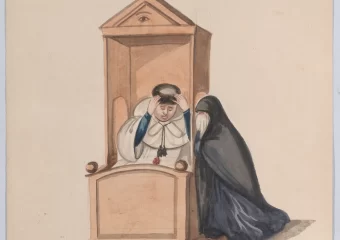
woman confessing priest, group drawings

We are continuing our thoughts from Psalm 32 about the depth of our sin. David begins the Psalm by reminding us, “Blessed is he whose transgressions are forgiven” (Psalm 32:10). He goes on to explain that when he kept silent about his sin, when he tried to cover it up, he was is torment and torture all day long (Psalm 32:3). But finally he understood what he needed to do – David has to confess his sin before the Lord.

David’s sin was against Bathsheba and Uriah. He could not confess his sin to a dead man. He might have confessed his sin to Bathsheba, but my guess is that she understood that once David penitently made his sins known to God.

What Does “Confess” Mean?

When we hear the word “confess” during the days of the season of Lent, the image that comes to mind probably includes recounting sins in a private session with a priest. The Sacrament of Penance – or Confession – is one of the seven sacraments of the Roman Catholic Church. In the New Testament, James encourages believers to “confess their sins to one another” (James 5:16). By the second century, church leaders encouraged confession and penance for “big” sins of apostasy, adultery, and murder committed after baptism. By the 8th century confession was a practice spread throughout the church. The Fourth Lateran Council (1215) made confession to a priest obligatory within a year of committing the sin.

Perhaps your idea of confession does not come from the Catholic Church at all, but from a persistent lawyer in a television series. On a witness stand before a judge and jury, the guilty party breaks down and admits participation in the crime, only after evidence, witnesses, and intense cross-examination by a gifted lawyer.

Perhaps there are threads of biblical truth in both of the images. Scripture emphasizes the importance of confessing sins both to God and to others. Confession leads to healing, forgiveness, and spiritual growth. Let’s look at a handful of Scriptures to further enhance our understanding of the biblical doctrine of confession.

A Biblical understanding

Let’s build our understanding on a couple of Old Testament concepts. Solomon warns, “whoever conceals their sins does not prosper, but the one who confesses and renounces them finds mercy” (Proverbs 28:13). The Psalmist writes, “Then I acknowledged my sin to you and did not cover up my iniquity. I said, ‘I will confess my transgressions to the Lord.’ And you forgave the guilt of my sin” (Psalm 32:5). Confession needs to be directed to God, but Solomon seems to also include confessing to others to find mercy and prosperity.

The principles of confession can be found in the Law. In Leviticus, we read, “when anyone become aware that they are guilty in any of these matters, they must confess in what way they have sinned” (Leviticus 5:5). In Numbers we are told, they “must confess the sin they have committed. They must make full restitution for the wrong they have done, add a fifth of the value to it and give it all to the person they have wronged” (Numbers 5:7).

New Testament clarification


The New Testament certainly deepens the teaching of the Old Testament. James tells us to “Confess your sins to each other and pray for each other so that you may be healed. The prayer of a righteous person is powerful and effective” (James 5:16).

This is such a powerful verse of Scripture on prayer and confession, but is so often misunderstood. Let’s examine it a piece at a time. In the minds of many, the most important word in the verse is the word “healed.” They see the verse as a gateway toward physical healing. The verse seems to also be teaching that only a really righteous person’s prayer is going to be effective.

But we know better – the Bible teaches us. Isaiah wrote, “We are all infected and impure with sin. When we display our righteous deeds, they are nothing but filthy rags. Like autumn leaves, we wither and fall, and our sins sweep us away like the wind” (Isaiah 64:6 NLT). Indeed, as it is written, “None is righteous, no, not one” (Romans 3:10 NIV).

I confess my iniquity; I am troubled by my sin.

Psalm 38:18 NIV

But believers do not stand on their own righteousness. For what does the Scripture say? “Abraham believed God, and it was counted to him as righteousness” (Romans 4:3 NIV). “For our sake he made him to be sin who knew no sin, so that in him we might become the righteousness of God” (2 Corinthians 5:21 ESV).

Of what do we really need healing?

What kind of healing could James be talking about? What kind of healing has a connection to sin? Of course, the obvious answer is the sickness of our sin. Does the Bible ever use the image of being healed from the sickness of sin by the cross of Christ? Yes! Again Isaiah says, “But he was wounded for our transgressions. He was bruised for our iniquities. The chastisement for our peace was upon Him. And by His stripes we are healed” (Isaiah 53:5 NKJV).

Peter emphasizes the same thing when he writes, “He himself bore our sins in his body on the cross, so that we might die to sins and live for righteousness; by his wounds you have been healed” (1 Peter 2:24 NIV).

So let’s think a little more about the word “confess.” What do we need to confess, and how do we go about doing it?

The word we translate “confess” is the Greek word ὁμολογέω (HOMOLOGEO). The word literally means “to say the same thing.” When we confess, what are we saying the same thing as?

We are saying the same thing that God says about our sin.

Disagreement with God arises about our personal sins. We tend to believe two things about our own sins: that our sins are not that bad and that we justify the reason we chose to sin. My sin – even just one of them – condemns me to hell. My sin – is my choice and responsibility – regardless of the circumstances. First, I need to admit my sins and own them. I confess that I fall short of the glory of God. Finally, I confess that my nature is not like the nature of God’s.

We confess that we need a savior.

If we under-estimate the depth of our sin, we over-estimate the value of our good works. Somehow, we imagine that God is keeping score each day: today it’s Good Works, seven; Sinful Acts, six. I confess that the wages of sin is death, but the free gift of God is eternal life through Jesus our Lord. There is nothing I can do on my own to change my nature.

We confess that we will forgive just as God has forgiven us.

Finally, when I understand how gracious God has been to me when he forgave my sin, how can I do anything but be gracious to others who have sinned against me? How often do I need to forgive someone else? Peter asked Jesus, “Must I forgive my brother seven times?” Jesus replied, “No, seventy times seven.” Was Jesus saying that we don’t need to go past 490? Of course not. He was saying we forgive countless times. Just like the previous lesson taught us that God does not “count” our sins against us. What if the sin was really grievous? If we ask that, we neither completely understand the nature of sin, nor the nature of God’s forgiveness.

We confess by the words we say to God, by the words we share with each other, and by the actions we take as we represent God to a world that doesn’t understand grace.