Five chalk tally marks on a black chalkboard; counts background.

So what should we count when we count the Omer? The first thing we count are the days. We are counting the days between the Passover and Pentecost. In Old Testament times, the Jewish people received God’s Law fifty days after the Passover. Through the Ten Commandments given to Moses, the people received God’s Word.

Each day represents a spiritual journey toward receiving God’s Word. When you were younger, did you ever have an extended vacation that became a journey? Think in terms of Chevy Chase’s family heading toward Wally World. If you were like me, you began counting things way before the vacation actually started. How many days till we leave? How many books do I need to take with me? How much spending money will I need to have?

One the journey started, my father would have us count things to help us pass the time and to keep us from asking, “Are we there yet? How much longer?” We would often count Volkswagen Beetles or keep track of how many different license plates we saw. It was always a thrill to find either Alaska or Hawaii. When we count things, the journey seems to pass more quickly.

What Counts? God’s Fingerprints

Here are a couple of spiritual things you can count while you progress on your journey during the next seven days. First, count the number of times you notice the fingerprints of God upon your life. Perhaps you barely escaped becoming involved in an automobile accident, or you were recently amazed when you noticed the vastness of the universe when you were gazing at the stars.

One day this week, everything that I did on my computer was crawling at a snail’s pace. Seven times the computer crashed during the day, each requiring a lengthy re-boot. But at the end of the day, when things had to be done, the computer put together 52 solid minutes of work without a crash – its longest streak of the day. I don’t believe it was Bill Gates watching over me – do you?

What Counts? Your Offerings

Next, count the times and ways you give back to God this week. Of course, count the money you give at church or to the charity, but be more creative in your counting. When did you show an act of kindness when you didn’t have to? When did you forgive your pesky, bothersome neighbor – again? When did you show the grace of Jesus to someone, when the stronger temptation was to demonstrate a demonic display?

What Counts? Your Prayers

Finally, count the times you stop to pray. Do you pray each morning and before bed at night? Do you pause before meals or special occasions? Are your prayers always requests? When was the last time you paused just to say, “I love you, Lord”?

Try to give yourself an accurate “count” this week; not like how you count your score on the golf course. Don’t wait until the end of the day and try to look back. “Yeah, Bobby, I had a four on that hole.” Count as you go – and even count the mulligans that you flubbed.

Count them – name them one by one – and it might surprise you, what the Lord has done.

Palm, Omer

Between the time of the Passover and Pentecost, the Jews developed a tradition called “Counting the Omer.” The tradition came from a passage telling the faithful to count the days and the weeks following the Passover. Let’s set the stage just a bit to help us understand.

My grandmother had a habit of counting things. “Count to ten,” she would say.

Whenever I would forget something (which was often) and have to go back inside the house to retrieve it, she would say, “Count to ten before you go.” Counting was supposed to help me make sure I hadn’t forgotten anything else.

Whenever I was about to lose my temper and get angry (which was often), she would say, “Count to ten before you do anything.” Counting was supposed to help me cool off before I said or did something I would later regret.

If I was having a difficult time falling asleep, she would say, “Count your sheep.” Counting sheep was supposed to be boring and put me to sleep. I have no idea where the sheep came from, how they orderly jumped over a fence, or where they went after they were counted.

Counting Slows Us Down

Counting things makes a hectic lifestyle slow down so that you can pay attention to the details.

Faithful Jewish believers have a habit of counting things also. Every spring they perform a ritual of counting the Omer. The Omer is a period of seven weeks – 49 days – from the Passover Seder to the holiday of Shavuot.

Since the Second Temple was destroyed, Jewish tradition has evolved so that the days are counted each evening in a particular way. Non-Jews, like myself, are invited to join with all of Israel with a little modification. At the close of the column, we will craft a ritual that we Christians can recite. Here are the steps in counting the Omer.

  1. Jews proclaim the blessing: “Blessed are you, LORD our God, King of the universe, who has sanctified us by his commandments and commanded us concerning the Counting of the Omer.” (Gentiles would not recite this sentence.)
  2. Declare the count:”Today is April 11th, nine days, which is one week and two days, of the Omer.”
  3. Pray for the Temple to be rebuilt: “May the Merciful One restore unto us the service of the Beit HaMikdash to its place, speedily in our days. Return your Dwelling Presence to Zion, your city, and send us Yeshua our Messiah. Let him reign upon the throne of David in Jerusalem, your holy city. Amen. Selah.”
  4. Read Psalm 67.
  5. Pray for purification and sanctification in preparation for Shavu’ot.

The inclusion of both the day (nine days) and the week (one week and two days) stems from a rabbinic argument about whether the Torah mandates counting days or weeks. The text of the Old Testament instructions both (“you shall count fifty days” and “you count seven complete weeks”) so this compromise position makes sure both bases are covered.

Omer Refers to Offerings to God

Why is counting the Omer significant? The period of time always marks a transitional moment from the season of spring into the season of summer. When the Temple still stood in Jerusalem, this was the period of time when Jews brought the “first fruits” of the new barley crops as a sacrificial offering. The word “omer” literally means “sheaf” (remember the old hymn, “Bringing in the Sheaves”) and refers to these offerings.

But the Omer is bigger than just the crops from the farms. The Omer connects the anniversary of the Exodus (the Passover) with the festival that remembers the giving of the Torah (the Ten Commandments) on Mount Sinai (Shavuot).

Count the Omer with Me

So, are you ready to count the Omer with me? Counting will slow down our lives and help us remember the blessings God has given us – especially through His Law. Each Saturday, we will count how many days we are from April 2nd on until we get to 50. We will have a prayer of blessing borrowed from the Apostle Paul, a counting of the Omer, a peek at a Scripture from Psalm 119 about God’s Law, and a prayer for the Lord’s Return. Here is our count for today:

  • “He who testifies to these things says, “Yes, I am coming soon.” Even so, Lord Jesus, come quickly!
  • Praise be to the God and Father of our Lord Jesus Christ, who has blessed us in the heavenly realms with every spiritual blessing in Christ and to Him who is able to do immeasurably more than all we ask or imagine, according to his power that is at work within us, to him be the glory in the church and in Christ Jesus throughout all generations, for ever and ever! Amen!
  • Today is April 11th, nine days, which is one week and two days, of the Omer.
  • We are grateful that the God who made the world and everything in it is the Lord of heaven and earth. He does not live in temples build by human hands but istead delights in His dwelling among us.
  • Psalm 119:7 – I will praise you with an upright heart as I learn your righteous laws.

counting the omer - the days between Passover and Shavuot, the giving of the Law

Thirty days in May. Growing up in Indianapolis, those words were shouted on the radio and plastered in the newspapers. Thirty days in May. My grandfather loathed counting thirty days in May.

Thirty days that you couldn’t shop at the Topp’s Discount Store (Walmart wannabe) in Speedway because of the crowds. During these thirty days the price of gasoline was hiked to forty-two cents a gallon. For thirty days you couldn’t ride your bicycle to the 40 Motel to get a bottle of Grape Crush because the crowd there was “unsavory.” But mostly thirty days that the Indianapolis Indians were on the road instead of at Bush Stadium because baseball couldn’t compete with Andy Granatelli’s turbine engines.

Grandpa loved baseball and particularly the minor league Indianapolis Indians. If the Tribe played an eight game home stand, it was not unusual for him to attend six of the eight games. During the thirty days of May, Grandpa was like a lost child wandering for glimpses of home. He would listen to the road games on his radio, an old tube-filled Westinghouse. He would sit in his chair by it, leaning his head and ear close, so that he could hear the play-by-play over the static. But he longed for the day when he could again see them in person.

counting the days to shavuot

Grandpa had a calendar in his bedroom upon which he wound up counting the days. A big red X marked through each passing day along with the number of the thirty days remaining. He always knew how many days had passed and how many days were left until the Indians returned to town.

Did you know that counting days in May has a biblical flavor? The Jews were instructed to count the days from the Passover forward for seven weeks. Each day was considered a measure of time – an omer to be counted. An omer was an ancient Hebrew measure of grain that equaled a little over three and a half liters. The measured days following the Passover carried both a spiritual and a practical significance for the Israelites.

From a practical standpoint, those seven weeks were in the spring as the people were planting and growing their crops. While those days provided a time celebrating the anticipated bountiful harvest, it was also a somber time of reflection. Agricultural communities were dependent upon successful harvests. Changes in the weather patterns or a harsh weather event could spell disaster for the entire community. This was a precarious time when the farmer spent many hours in prayer for God’s blessing over the growing season.

The seven weeks also carried an important spiritual significance. Seven weeks after the first Passover, the people of Israel were camped at the base of Mount Sinai. It was here where God spoke directly to Moses and he received the Ten Commandments and the giving of the Law. The lives of the Israelites would never be the same because God spoke. They counted each word as important. They remembered the number of days they spent awaiting His words.

principles for counting

The Israelites were to learn two very important principles by counting. First, they were to see that in spite of all the preparation and planning, the daily events of life like planting and tending the fields were really not completely in their control. Without the blessings of God, the things they counted on as necessities of life were as fickle as the wind.

Second, if the Israelites were to hear God’s words, they had to prepare their hearts and their ears. They were camped at Mount Sinai for three days before God spoke. Many of the people spent the entire time awake – prayerfully anticipating what God would say.

We would do well to learn the lessons of counting. Life is bigger than we are. It isn’t left just left to chance or fate. Our best efforts to control it don’t even corral it. And if we want to hear the whispered words of truth over the boisterous shouts of life, we must purposely lean our heads and ear to the source in order to hear the sound over the static.

From today on, let’s count the seven weeks – and we will add a day because of the newspaper’s schedule. We will examine what God is doing through nature. Let’s count the blessings that He graciously provides for us. Our minds will reflect on the things that are important during this particular season of life. Let’s count the words of truth that God provides.

We notice the number of steps of our journey. Perhaps we will measure the goodness of the moments. Let’s long for the day when gasoline was forty-two cents a gallon. And at the end, we’ll celebrate by riding up and getting a Grape Crush. I’ll buy.

counting the Omer

Thirty days in May. Growing up in Indianapolis, those words were shouted on the radio and plastered in the newspapers. Thirty days in May. My grandfather loathed counting thirty days in May.

Thirty days that you couldn’t shop at the Topp’s Discount Store (Walmart wannabe) in Speedway because of the crowds. During these thirty days the price of gasoline was hiked to forty-two cents a gallon. For thirty days you couldn’t ride your bicycle to the 40 Motel to get a bottle of Grape Crush because the crowd there was “unsavory.” But mostly thirty days that the Indianapolis Indians were on the road instead of at Bush Stadium because baseball couldn’t compete with Andy Granatelli’s turbine engines.

Grandpa loved baseball and particularly the minor league Indianapolis Indians. If the Tribe played an eight game home stand, it was not unusual for him to attend six of the eight games. During the thirty days of May, Grandpa was like a lost child wandering for glimpses of home. He would listen to the road games on his radio, an old tube-filled Westinghouse. He would sit in his chair by it, leaning his head and ear close, so that he could hear the play-by-play over the static. But he longed for the day when he could again see them in person.

counting the days to shavuot

Grandpa had a calendar in his bedroom upon which he wound up counting the days. A big red X marked through each passing day along with the number of the thirty days remaining. He always knew how many days had passed and how many days were left until the Indians returned to town.

Did you know that counting days in May has a biblical flavor? The Jews were instructed to count the days from the Passover forward for seven weeks. Each day was considered a measure of time – an omer to be counted. An omer was an ancient Hebrew measure of grain that equaled a little over three and a half liters. The measured days following the Passover carried both a spiritual and a practical significance for the Israelites.

From a practical standpoint, those seven weeks were in the spring as the people were planting and growing their crops. While those days provided a time celebrating the anticipated bountiful harvest, it was also a somber time of reflection. Agricultural communities were dependent upon successful harvests. Changes in the weather patterns or a harsh weather event could spell disaster for the entire community. This was a precarious time when the farmer spent many hours in prayer for God’s blessing over the growing season.

The seven weeks also carried an important spiritual significance. Seven weeks after the first Passover, the people of Israel were camped at the base of Mount Sinai. It was here where God spoke directly to Moses and he received the Ten Commandments and the giving of the Law. The lives of the Israelites would never be the same because God spoke. They counted each word as important. They remembered the number of days they spent awaiting His words.

principles for counting

The Israelites were to learn two very important principles by counting. First, they were to see that in spite of all the preparation and planning, the daily events of life like planting and tending the fields were really not completely in their control. Without the blessings of God, the things they counted on as necessities of life were as fickle as the wind.

Second, if the Israelites were to hear God’s words, they had to prepare their hearts and their ears. They were camped at Mount Sinai for three days before God spoke. Many of the people spent the entire time awake – prayerfully anticipating what God would say.

We would do well to learn the lessons of counting. Life is bigger than we are. It isn’t left just left to chance or fate. Our best efforts to control it don’t even corral it. And if we want to hear the whispered words of truth over the boisterous shouts of life, we must purposely lean our heads and ear to the source in order to hear the sound over the static.

From today on, let’s count the seven weeks. We will examine what God is doing through nature. Let’s count the blessings that He graciously provides for us. Our minds will reflect on the things that are important during this particular season of life. Can you count a different blessing each day? Let’s count the words of truth that God provides. Each day we will look at a verse of Scripture from Psalm 119.

We notice the number of steps of our journey. Perhaps we will measure the goodness of the moments. Let’s long for the day when gasoline was forty-two cents a gallon. And at the end, we’ll celebrate by riding up and getting a Grape Crush. I’ll buy.

flower, crocus, crocus flower, blossom, bloom, music, sheet music, songs, concert, easter songs, easter, spring, spring songs, to sing, choir, make music, spring awakening, beginning of spring, crocus flowers, teacher gradebook, grades, notenblatt

Happy Easter! The wonders of celebrating the resurrection of our Lord. He is not here. He has risen! While we always think of our resurrected Lord, this morning I also want you to think about something for which to be thankful.

Music has always been a huge praise driver for me, but especially on Easter Sunday. What are the songs of your resurrection Sunday?

Was your day a day of hymns? People my age grew up in a church that sang hymns – usually the first, second and last stanzas. Were your songs hymns today? While staples of “The Old Rugged Cross,”  “When I Survey the Wondrous Cross,” and “There is Power in the Blood” may have led us to the resurrection, our Sunday mornings on Easter were filled with “Christ the Lord is Risen Today,” “Up from the Grave He Arose,” “Crown Him with Many Crowns,” and “He Lives!”

A Day of Hymns or A Day of Praise?

One year in college we tackled the peak of the mountain. Our choir performed the magnificent oratorio the “Messiah.” Beginning with the prophecies from Isaiah and the annunciation to the shepherds, the bulk of the music concentrates on the passion of Christ and ends with a chorus of Hallelujahs. Handel wrote “Messiah” for modest vocal and instrument presentation, though in the years following his death the work was adapted for a much larger scale, including giant orchestration and choirs.

In my years after college, contemporary Christian music tried to walk a strange fine line between the Eagles and Journey, between praise and rock. Kentucky born songwriter Don Francisco penned a Dove Award winning “He’s Alive,” a song covered by Dolly Parton, Ray Boltz, and the Brooklyn Tabernacle Choir. Sandi Patty performed “Was it a Morning like This?” and Glad offered a rendition of the “Easter Song.”

Origins of Contemporary Praise

Contemporary praise and worship music on Easter these days feature Chris Tomlin’s “The Wonderful Cross” and “How Great is Our God,” Phil Wickham’s “This is Amazing Grace,” Laura Story’s “Death Was Arrested,” or Passion’s “Glorious Day.” 

I have told this story to almost anyone who will listen. One of the Christian rock groups of the 1970s and 80s was a group called Petra. The music group is regarded as a pioneer of Christian rock music. With more than three decades of experience, the band released 20 studio albums, earned nominations for 13 Grammy awards, and sold about 10 million copies of music. Petra became the first rock band inducted into the Gospel Music Hall of Fame and the first Christian band to have their memorabilia included at the Hard Rock Café chain.

I got one of their early cassettes and had it playing in the car when my dad got in to ride with me. Dad was an active leader in our church, serving as a Deacon for years. “Dad wouldn’t it be great if we could sing music like this in church?”

A grin came over my dad’s face. Actually, it leaned more toward a smirk. “We will never sing music like that in church.” The odds were in his favor. We hadn’t changed music in millenniums.

Twice today my oldest daughter Sarah plays bass in a praise and worship band that would make Petra sound like the opening act for Bill ad Gloria Gaither. And once yesterday. Friday.Thursday. And lots of practices beforehand.

An Eternity of Praise

While Casting Crowns, Hillsong, MercyMe and Newsboys play occasional concerts and earn a fair wage, across the country in almost every size church, musicians offer their time and talents for little or no monetary compensation. This message is for Aunt Martha as she plays the organ in a rural church in Georgia and the guy who just learned to play three chords on a guitar in Ohio. Thank you from the bottom of my heart for doing something that few of us can do.

I know how tiring giving of yourself is at church. There have been many times when I have given multiple sermons on the same day. I have taught more than one Bible lesson on the same day. It is both exhilarating and exhausting.

Playing music is something that most of us wish we could do. I am thankful that you have seen fit to use your talents in music and your gifts in leadership and interpersonal relationships to present and direct our worship. God must be so proud as you rally us together and lead us on a journey to His majestic throne room.

How Can We Say “Thanks?”

Thank you for your dedicated hours, your sore throats from singing, your tired feet from standing, the callouses from playing your instrument and your service to our church and our God. Literally we could not do Easter without you.

You set the mood for our service. We move one step closer to our Father. You make us smile when you share your gifts.

If there are stars on crowns when we get to heaven, you will have many. An angelic messenger will meet you at the gate with a new set of strings. He will hand you a note that says “Worship is at 10:00am. Bring your instrument.”

Thank you musicians for your ability to lead us in praise. To God be the glory. Happy Easter.

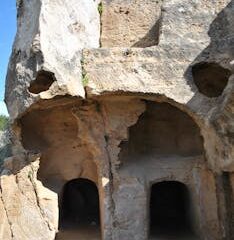
Explore well-preserved ancient rock-cut tombs with distinct entrances, showcasing historical architecture.

Years ago, when I was in third grade, our youth group leader asked the class, “What is the most difficult part of being a Christian?” The class had a variety of answers – I don’t even remember what my response was – but sixty years later, I know what I would have answered.

The most difficult part of being faithful is waiting.

Difficulty in Waiting

“They that wait upon the Lord shall renew their strength” (Isaiah 40:31). But I want – I need – my strength now. I don’t want to wait.

“And so after waiting patiently, Abraham received what was promised” (Hebrews 6:15). But Abraham and Sarah waited twenty-five years before the birth of Isaac! Think of what they went through during those years. How can we wait that long for God?

“Jesus told his disciples, ‘Wait here while I go over there and pray’” (Matthew 26:36). Within the hour, Jesus’ closest disciples had drifted to sleep. The spirit is willing …but it is so difficult to wait.

The other day I was sitting at the ballpark waiting for the baseball game to begin. As I noticed about twenty minutes on the clock before the first pitch was scheduled, I instinctively pulled out my cell phone and began to play my favorite word search game. Some people go to Facebook; others flip through photographs. What is your habit for wasting time when you are doing nothing?

We tend to think the same way when we are waiting on God. It is easy to perceive that we – and God – are just wasting time. Let’s shift our thinking to understand that God is up to something while we wait. Here are some concrete actions that you can do while you wait.

While You Wait

First, make a routine for spending time regularly with God. Carve out some of your “prime-time” moments and dedicate those each day for praying to God or for reading Scripture. Being with God will keep us from being distracted and allowing our minds to wander into worry and doubt.

Think about what happens when you haven’t heard from one of your adult children or a good friend. We begin to think, “Has something happened to them?” or “Are they mad at me?”  Before long, we question what we have done wrong. We become convinced that the person has forgotten about us.

God is Up to Something

We tend to think the same things about our relationship with God. I have sinned so much God has abandoned me. My problems are too much – even for God. He has either forgotten about me or maybe He doesn’t even exist.

Don’t give God the six minutes before you fall asleep. Take the moments of your day when you are at your best. It is easy for my mind to wander when I pray. During these important times of praying, I often write out my prayers. When my eyes are not closed and I am writing things on paper, my mind stays sharp and focused.

Second, spend time with other believers who you trust. When times are challenging, many of us withdraw from activities and being with others. During these times, we need the encouragement and accountability that comes from other people. We are a much stronger, more resilient people when we are with others. There is a reason that Solomon told us that two or three cords together are not easily broken.

Finally, look for specific things that you can do to be of service to others. Volunteer at a local shelter, offer to help do things around your church building, or spend time working for your favorite charity. Instead of just tapping your feet impatiently, tap into the strength that comes from being a help to others.

Saturday Summary

Solomon offered this conclusion as he pondered the meaning and purpose for life: “Now all has been heard; here is the conclusion of the matter: Fear God and keep his commandments, for this is the duty of all mankind (Ecclesiastes 12:13 NIV). Paul put it this way – “For we are God’s handiwork, created in Christ Jesus to do good works which God has prepared in advance for us to do” (Ephesians 2:10 NIV).

When we are waiting on God, he orchestrates events and answers beyond our wildest imagination. The disciples were waiting, feeling hopelessly abandoned by a Savior whose life was snuffed out by an indifferent government and misguided religious leaders.

While you are waiting, always remember, “It’s Friday, but Sunday’s coming!”

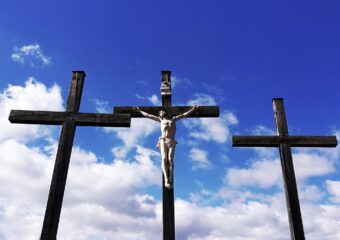
cross, calvary, golgotha, good friday, religion, easter, prayer, mariazell, calvary, calvary, calvary, calvary, calvary, golgotha, golgotha, good friday, good friday, good friday

   The headlines on news service websites over a year ago were startling. 79 million Americans braced for the worst as damaging tornadoes formed in Missouri and start their march eastward. Tornadoes were confirmed in the early hours of Wednesday morning near Glenallen, Missouri. Fatalities and injuries have already been reported. Fierce weather patterns again hit too close to home.

   The latest weather outbreak came on the heels of the previous week’s even harsher weather. Over 100 tornadoes ravaged through six states killing at least 31 people and injuring 150 others. President Biden opened the way for federal resources to help offset the financial devastation.

A Grim Reality

   The weather may put a damper on plans, but it does not drown our sorrows. Our hearts are still heavy from the tragic developments around the world. The world is filled with wars and rumors of wars. Research websites estimate that at any given moment 50 to 60 countries around the world are engaged in war. Hardly a month goes by that we do not read of a former student carefully plotting an attack aimed at killing children adults at a religious school. Killers force entry into buildings with two assult-style weapons, a handgun, and ample ammunition.

   According to the Gun Violence Archive, most years record over 600 mass shootings (where at least four people are injured) in the United States this year, over a dozen involving a school. These shootings, terrifying students, parents, and educators, polarized the nation over gun rights and what to do to ensure safety. Education Weekly counts 157 school shootings since 2018. When is enough, enough? 

   Meanwhile, Ukrainian defense forces continue to repel Russian attack forces. Iran responds to United States and Israeli missile attacks with a bombardment of weaponry of their own. Is the world painting itself into an inevitable corner of war?

   Sin – or incredibly bad decisions – is running rampant. We are at the end of our week and the end of our rope.

A Friday Centuries Ago

   A little over two thousand years ago, the hours were ticking off to the end of a week. We call the Friday “good,” but the day would have been more appropriately called “grim.” A man was stretched out to be crucified on a cross erected on one of the hills of Palestine. This man wasn’t the first. By the time of his death, historians estimate that the Romans had put as many as 30,000 people to death in such a fashion. 

   Peter reminds us, though, that this death was unique: “the righteous for the unrighteous, that he might bring you to God” (1 Peter 3:18). Accompanying the death of Jesus were some incredibly unusual events. John MacArthur, evangelist and author, explains these events “are God’s commentary on the cross.”

   Mark tells us that Jesus was placed on a cross at about 9:00am (Mark 15:25). Matthew explains that “from noon until three darkness came over the whole land” (Matthew 27:45). In the Old Testament, darkness was often a sign of judgment (Amos 5:18). Remember darkness came over the land of Egypt for three days as a result of the ninth plague (Exodus 10:21-22). Darkness came before the final plague: death.

Curtains and Quakes

   Matthew next adds that “the curtain in the sanctuary was torn in two from top to bottom” (Matthew 27:51). Some scholars suggest the curtain is what separated the court of the Jews from the court of the Gentiles, particularly keeping the holy of holies from the other parts of the temple. Tearing this curtain signifies the opening of a way for all people to directly approach God.

   Matthew then adds “the earth quaked, and the rocks were split” (Matthew 27:51). While earthquakes were common in the area, this was more than just a common event. Warren Wiersbe connects the quake with the presence of God – something that happened with God was giving Moses the ten commandments at Mt. Sinai. Wiersbe suggests that this earthquake showed that the demands of the Law were about to be fulfilled.

   Finally, Matthew explains “the tombs were also opened and many bodies of the saints who had fallen asleep were raised” (Matthew 27:52). Many theologians see this event as a declaration of another resurrection that would be just days away. But on this particular day, the tomb stretches forth its boney arms to welcome another into its clutches.

Friday Traditions

   Throughout the history of Christianity, Tenebrae services have been held in churches, often during each of the last three days of Holy Week. Liturgical worship services are held in Catholic, Anglican, Lutheran, Methodist, Reformed, some Presbyterian and a few other denominations on Maundy Thursday, Good Friday, and Holy Saturday. The word “tenebrae” is Latin for “darkness” or “shadows.” The services are characterized by the gradual extinguishing of candles and by a “strepitus” or loud noise which ushers the place into utter darkness at the end of the service.

   The traditions of the Roman Catholic church settled on 15 candles providing the lighting for the service. One candle was extinguished after each of nine psalms were read during the ceremony. The final candles were put out as chants and prayers were given. Following the great noise of the slamming of the large family Bible, the congregation would rise and depart in silence and darkness.  

   The Tenebrae provided an impressive symbolic image of our world today. Stained by sin, the world uneasily rests, plunged into the depths of darkness, void of anything but empty shadows, facing a future with no hope. We don’t need to read too many headlines to know this is where our world still sits.

   With his last gasps of air, Jesus whispers, “It is finished,” bringing his Friday and ours to an end. But even in darkness, don’t lose sight of the light at the end of this tunnel.

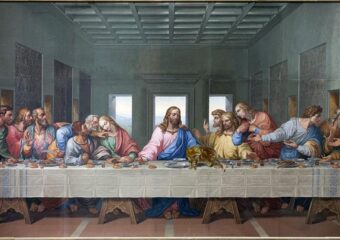
jesus, last supper, cat, painting, art, last supper, last supper, last supper, last supper, last supper

We continue to move through the days of Holy Week. Today, we come to what the church has identified as “Maundy Thursday.” The Maundy in Maundy Thursday comes from the Latin mandatum which means commandment.

The word is taken from a phrase Jesus uttered during the Passover meal: “A new commandment I give to you that you love one another” (John 13:34).

The Passover meal was filled with unexpected surprises and incredible teaching moments. Let’s talk about three important lessons.

Thursday Towels

For the sandal-wearing disciples, washing feet was a common occurrence. It was proper hospitality to offer guests to your home a basin of water for their feet.Guests were expected to wash their own feet unless you owned slaves. Even Jewish servants were exempted from washing feet.

Edersheim says, “There is no instance in either Jewish , Greek, or Roman sources of a superior washing the feet of an inferior.”

When Peter protested Jesus washing his feet, Jesus said that while Peter did not understand what was happening, one day it would all make sense for him (John 13:13-17).

Introspection

Later in the evening, Jesus explained to the disciples that one of them would betray him. The disciples would understand what a betrayal was, but understanding how Jesus could be betrayed was probably beyond their imagination.

One by one, the disciples asked, “Is it I, Lord? (Matthew 26:22)” The Scripture says they were deeply grieved and were prompted to ask.

Isn’t it interesting that they didn’t say, “It won’t be me, Lord?”

The only requirement for betrayal is that the person be close enough to the individual to actually betray. Enemies can’t betray. Indifferent acquaintances would not be motivated. It takes a friend to betray a friend.

While only one betrayed Jesus directly, all but one abandoned him. Only John stayed at the cross during the crucifixion.

There is a significant truth contained in this passage. When the disciples each asked, “Is it I, Lord?” Jesus could have answered, “Yes.”

At one time or another, each of them would betray the trust that Jesus placed in each of them.

We must not lose sight of the truth. The answer is also, “Yes,” for each of us.

Blood & Forgiveness

During the Passover meal, Jesus took bread and wine that reminded the faithful of the sacrifice of the Lamb for forgiveness and freedom. Jesus applied the images to what he was about to do at Calvary. Listen to Jesus’ words.

And after taking the cup and giving thanks, he gave it to them, saying, “Drink from it, all of you, 28 for this is my blood, the blood of the covenant, that is poured out for many for the forgiveness of sins.

Jesus tells two important details in this verse. He explains that his blood begins a new covenant. One doesn’t enter into a new contract unless the old one is no longer valid. The essence of Jesus’ sacrifice was to secure our forgiveness.

Maundy certainly describes this Thursday.

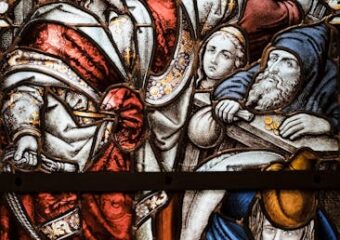
Detailed stained glass window showing a biblical scene with vibrant colors and intricate design.

Traditionally, the church has accepted that Jesus taught in the Temple area on Wednesday of Holy Week. They place the Last Supper – the celebration of the Passover meal – on Thursday. We will cover events in this way, realizing that probably the Passover meal was celebrated on what we would consider Wednesday evening. Earlier hours on Wednesday were likely spent making preparations for the day.

At some point during Holy Week, Jesus teaches about two different subjects which we need to discuss. Personally, it seems to easily fit with his teachings on Tuesday. We will cover both topics here today.

Woes to the Pharisees

In the 23rd chapter of Matthew, Jesus speaks directly to the Pharisees about the weaknesses in their lives. We will look at a couple of the “woes” individually, but first we need to think about why it was so easy for these religious leaders to become hypocritical – and why it is such a danger for Christian leaders – elders and preachers – even today.

Religious leaders – then and now – can easily fall into the temptations of hypocrisy. The attitude comes about because of the pressures to live a faithful, holy life; the temptation to use rules to manage behavior; the ego-driven desire to be held in high esteem by others; and the ego-driven desire to be in control. In addition, practically most of us do not like our own actions to be questioned.

C.S. Lewis offered some pointed observations, noticing that arrogant condemnation is a first cousin to hypocrisy. This way of thinking seeks to conceal my hidden sin by exposing your supposed sin. Says Lewis, “All the worst pleasures are purely spiritual: the pleasure of putting other people in the wrong, of bossing and patronizing, and spoiling sport, and back-biting, the pleasures of power and hatred.”

Listen to Jesus’ scathing words:  “Woe to you, teachers of the law and Pharisees, you hypocrites! You give a tenth of your spices—mint, dill and cumin. But you have neglected the more important matters of the law—justice, mercy and faithfulness. You should have practiced the latter, without neglecting the former. 24 You blind guides! You strain out a gnat but swallow a camel” (Matthew 23:23-24).

Truth be told, we have all swallowed a few camels in our day, haven’t we?

Welcome Home

Jesus also spends a significant amount of time talking about the future. He warns about the destruction of the Temple, but points to a day in the future when the Father will welcome his children to an eternal home.

“Do not let your hearts be troubled. You believe in God; believe also in me. My Father’s house has many rooms; if that were not so, would I have told you that I am going there to prepare a place for you? And if I go and prepare a place for you, I will come back and take you to be with me that you also may be where I am” (John 14:1-3 NIV). 

“Prepared for you.” An amazing thought. Have you ever had an opportunity to design and decorate a new building that you would use? Whether it be for business or church, or for your own personal living space, having the chance to have things just the way you would like them to be is a wonderful experience.

The message of Wednesday is that God has prepared an eternal home for you. He has made it with you in mind. He has considered all of your needs and desires. And he spared no expense.

Welcome home, my child, welcome home.

Close-up of hands exchanging various currency bills, highlighting money transactions.

As our devotions continue during the days the church labels “Holy Week,” it is important to keep our focus upon Christ’s earthly mission – to secure redemption for the sins of mankind. More than likely, the events of Holy Week provide context and explanation that the sacrifice of Jesus would fulfill the Law’s requirement for the punishment of sin. In addition, the events were skewed to help the religious leaders understand how they had been misinterpreting the Scriptures.

Each evening during the early part of the week, Jesus and the disciples appear to have spent the night with their good friends, Mary, Martha, and Lazarus in the small village of Bethany. How far was Bethany from Jerusalem? The Bible helps us to know the distance. John tells us that Bethany was located about two miles east of Jerusalem (John 11:18). The distance was considered a “Sabbath’s day journey” – the distance you could legally travel on the Sabbath (Acts 1:12).

Evenings in Bethany

Residing with the friends was not just a matter of convenience. No more than a few weeks prior, Lazarus had been raised from the dead by the Savior. The greatest of object lessons should have kept the image of an empty tomb in front of the people. Jesus certainly gave the disciples enough hints about the probability of a resurrection.

The ancient road between Bethany and Jerusalem was a well-traveled pathway in New Testament times. The road was on the eastern slope of the Mount of Olives, making it the main road for travelers entering or leaving Jerusalem during the time of feasts.

Traveling to Jerusalem, the path was rugged and almost constantly uphill. Flanked by olive gardens and rocky terrain, the road meandered through the narrow Kidron Valley as it worked its way up to the city gates. The path offered breathtaking views of the Temple complex. The steps allowed people to reflect and contemplate, as the journey served as spiritual exercise much more than just physical.

A Matter of Chronology

Before we continue to think about some of Jesus’ teaching on Monday, we need to consider a couple of points of chronology. First, in what year was Jesus crucified? Church tradition has accepted either 30AD or 33AD. Depending on the year, the actual days of the Passover would vary. Pilate was governor over Judea from 26 to 37 so a variety of years would have been possible. Most branches of Christianity accept 30AD as the year.

We must also remember that the Jewish day was counted from sundown to sundown. Our day begins in the middle of the night at midnight. But the Jewish “day” began at suppertime. If the Passover was on a Thursday, then the Passover meal would have been eaten on Wednesday before the sunset. The calendar below will help visualize the concepts.

Holy week

As Jesus approached Jerusalem, he passed a fig tree which would have provided a nice snack for the journey. The tree appeared to be healthy – it has already blossomed and had leaves. But there were no evidence of a single piece of fruit on the tree.

We are told that Jesus cursed the tree. Don’t think of him as mad and spouting foul language. Cursing the tree meant proclaiming a statement of judgment against it. Because the tree wasn’t what it was supposed to be doing, it was not able to nourish people. The lesson for authentic and genuine Christianity seems obvious.

Monday Merchants

When Jesus entered the Temple courtyards on Monday, he was struck by the number of merchants in the area. The Passover was big business for Jerusalem and the religious leaders. Merchants provided a service for the people. They were there for convenience. People were required to sacrifice and a variety of animals and grains could be used for the process. Because many people traveled distances to come to Jerusalem, it was easier for people to buy what they needed in the courtyard area.

Think about trying to get a hotel in Louisville during the week of the Kentucky Derby. Prices skyrocket because local merchants want their bottom line to be profitable. If a small dove would normally sell for $5, during the Passover, it would likely cost $20.

Money changers were also present in the Temple courtyards. Almost every country minted their own coins. The Temple likely only accepted Hebrew coinage for offerings. Money changers helped the people by exchanging the Greek coinage for Hebrew currency. Of course, they offered this service at a hefty profit.

Jesus chased out all of the merchants and bankers. If there is a lesson in this story for today, it might be wise to ask how much have we made worship a matter of convenience? If we no longer have to attend church because it streams on our computer, have we taken away a portion of what makes worship, worship?

Throughout the day, people questioned Jesus’ authority to teach and do the things that he did. Some were quick to say, “No one has every taught with such authority.” The religious leaders were upset because Jesus did not follow their constructed chain of command.

In the end, Monday was a day that stressed the sincere and genuine nature of faith.