wrangling with words

Did you ever read something in a book or printed page that made you stop and reread it? It hit you and it was almost like you couldn’t believe what your eyes read? Perhaps it was a statistic that was so astonishing. Maybe it was a quotation that you couldn’t believe so-and-so said that!  So you were compelled to read it again, just to make sure. Instead of looking just to comprehend the big picture, you looked closely at each word to find nuances and meaning.

You read it again and paused. You noticed. And thought. And nodded. And you understood.

Jesus taught the importance of celebrating. The Master loved to tell stories. You would have been spell-bound to listen to Him because He had a knack for taking the most profound spiritual truths or doctrines and make them as simple as learning to throw seeds in the garden or baking a loaf of bread. A story – an object lesson – used to tell a spiritual truth is called a parable. About a third of His teaching used parables, and depending on how you count, Jesus told about forty different parables.

He speaks in parables because not everyone wants to hear. He used parables so that the hearts of those rejecting His words would not be hardened further. The same sun that softens the wax hardens the clay. The same gospel that humbles the heart of the honest seeker hardens the heart of the one who is clinging to their path of disobedience.

William Barclay wrote, “The parable conceals truth from those who are either too lazy or too blinded by prejudice to see. It reveals truth to him who desires truth; it conceals truth from him who does not wish to see the truth.” D.A. Carson states, “the parables spoke to the crowds do not simply convey information nor mask it, but challenge the hearers.”

Understanding parables

The term “parable” is a transliteration of the Greek word parabole (parah-bow-lay). The word means “to throw alongside.” A parable throws one idea alongside another for the purpose of providing a better explanation. The story in a parable illustrates and illuminates basic ideas and is not meant to have an “item-by-item” explanation for each detail, but rather a larger picture painted on the canvas.

The word starts with the Greek preposition “para.” It literally means alongside, but it stresses a nearness, a closeness or a relationship that is often not expressed in translation. It implies an intimate relationship, something that actually changes the nature of the two when separate and individual.

Let me give you an example. I might call your attention to “peanut butter alongside jelly.” We could be picturing a jar of peanut butter and a jar of jelly sitting next to one another on the kitchen cabinet or on the shelf at the grocery. But if the word “para” was used to describe “alongside” we would not think of the peanut butter and the jelly as separate, but instead we would think of them as already intermingled, as in a peanut butter and jelly sandwich.

We bring the word “para” straight into the English on so many occasions. We often speak of a parachute, paradigm, paragraph, paralegal, paralysis, parameter, or paradox.

My two sons

The fifteenth chapter of Luke (Luke 15:1-31 ESV) describes an interesting point in the earthly ministry of Jesus. In the midst of intense criticism from Jewish religious leaders regarding His practice of eating with characters of ill-repute, Jesus tells three stories. The imagery wrestles your attention away from any other direction.

Do any of you have sheep? There was a woman who had coins. Once a man had sons. Everyone can relate to these stories. Haven’t we all had a pet that got off the leash and wandered away? Is there anyone among us that hasn’t misplaced our keys or our cell phone? Could there be a parent whose child never made a bad decision?

I finally found it! It was in the last place I looked! He came to his senses and it all worked out.

All three of the stories have similar circumstances. The stories all teach similar lessons. And all three stories end the same way: we call friends and neighbors and say, “Let’s celebrate! I found what I lost!”

wrangling with words

Did you ever read something in a book or printed page that made you stop and reread it? It hit you and it was almost like you couldn’t believe what your eyes read? Perhaps it was a statistic that was so astonishing. Maybe it was a quotation that you couldn’t believe so-and-so said that!  So you were compelled to read it again, just to make sure. Instead of looking just to comprehend the big picture, you looked closely at each word to find nuances and meaning.

You read it again and paused. You noticed. And thought. And nodded. And you understood.

Think for a moment about one of the concepts in this passage: building. When Nehemiah was able to paint the correct picture to the people, and mapped out a plan for them to follow and rebuild, the people responded positively. The time is now. The culture is in despair. The walls and structures of society are in shambles.

Come. Let’s start rebuilding. The Lord will give us success.

Building walls is taking responsibility for who you are and who God is calling you to be. Do you see the difference? There are parts of who we are that are not who God wants us to be. We are to take responsibility for our sins. That is difficult and humbling. We want to blame someone or something else for who we are. It’s my parent’s fault. I am the product of my culture. I need to take responsibility for my sins and I need to repent of them.

God is in the process of building, building a new way. In Nehemiah’s day, it was shifting from the Law to grace. In the New Testament, Jesus said, “I am the Way, the Truth and the Life (John 14:6 ESV). The early church were known as followers of the Way, often shortened to just “The Way.” It wasn’t a name claimed by their own; it was a name bestowed upon them by others.  These followers of Christ were first called “Christians” by the leaders of the community in Antioch (Acts 11:26).

The interesting – and quite unusual – thing about this is that sects of the Jewish faith usually did not get a distinctive name among the Gentile population. The Jewish faith had different sects, groups like the Pharisees and Sadducees and Essenes and several others, but to the outside world they were all Jews. So why weren’t Christians simply lumped in with all the other variants of the Jewish faith?

A little context to the culture might help. Antioch became the first major city outside of Judea to be touched by the message of the gospel. The city of Antioch was often referred to as “all the world in one city.” You could see the riches and diversity of the entire world located in the city of Antioch. The city was designed like most cities of the day – a circular wall surrounding the boundaries of the city and inner marketplace at the center of the city, serving as its hub. From the hub of the city were inner walls, sometimes constructed, but sometimes natural barriers that served as spokes reaching from the hub to the outer wall. The spokes marked ways that divided different people groups from one another. Jews from Gentiles. Rich from poor. Color from color. All cities followed a similar pattern. Each of these walls were known as “ways.”

Until the Christians came to Antioch. Here the message of reconciliation of the gospel came across in stark contrast to the design of the city. There is no male nor female – gender, something that was a huge divide in the early world. There is no Jew nor Gentile – race and religion, two more dividing walls in the boundaries of the city. There is no rich or poor, slave or free – economy and education, two more avenues that separated the city.

The people of Antioch were amazed, but also astute. “These Christians are followers of the WAY,” they said – meaning Jesus.

But I don’t think the people of Antioch said it like that. I think they said,

“The people are followers of THE Way.”

THE Way that tears down walls. THE Way that builds new walls. THE Way that leads to the Father.

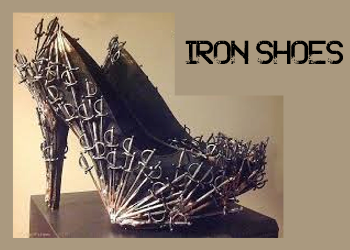
Newspaper articles: Iron Shoes, rough, long, lonely, home

Do you make resolutions for the new year? If you do, you are certainly not alone. According to Forbes magazine as many as 45% of Americans make promises of change for the coming year. For perspective, the Super Bowl, the most watched television event – the one that drives commercials and spending in unimaginable ways – draws only about a third of all Americans. While resolutions are on our minds, they aren’t always in our hearts. This year, instead of thinking about resolutions, let’s think about how God prepares us for this year’s journey by fitting us with right kind of shoes – sometimes even iron shoes.

What are the most relentlessly promised resolutions? According to the Journal of Clinical Psychology published by the University of Scranton, the top ten resolutions, in order, are losing weight, getting organized, spending less and saving more money, enjoying life to the fullest, staying fit and healthy, learning something new and exciting, quitting smoking, helping others achieve their dreams, falling in love and spending more time with the family.

But for all our good intentions, the same study reveals that only about 8% actually keep the resolution for more than six months. Why do so many fail at goal-setting and keeping? More importantly – are there keys for success shared by the 8%?

I have resolved that this year I will make no resolutions. Let me tell you a story that got me thinking.

Not too long ago, I needed to buy a new pair of tennis shoes.

I went down to the shoe store and told the clerk I needed tennis shoes. He said, “What kind of tennis shoes do you need?” He was right. There were all kinds of tennis shoes. There were tennis shoes for baseball, cross country, track, basketball, biking and working out. There were even tennis shoes for tennis. I had to know what kind of tennis shoes I needed.

What kind of shoes are you wearing? It kind of depends on what you are planning to do, doesn’t it? The matter of shoes is important. Our shoes help prepare us for the task.

God prepares us for a task by providing us with the right kind of shoes.

We are going to start the year by remembering a very simple lesson. God prepares us for a task by providing us with the right kind of shoes. Would you believe that there are times that He provides us with iron shoes?

There is an obscure passage of Scripture in the Old Testament book of Deuteronomy that deserves our attention for the next few weeks. It is a verse that is not easily translated. The passage of Scripture is Deuteronomy 33:25. The New International Version translates it this way:

The bolts of your gates will be iron and bronze, and your strength will equal your days.

Many of the translations of the Bible give it a similar flavor. But look at how the New King James Version translates the verse. “Your sandals shall be iron and bronze; As your days, so shall your strength be.”

The truth is either translation is appropriate. The question is, in context which makes the most sense? The Hebrew language is made up of only consonants. The vowels come from the context and traditions of the oral language. Just like the English consonants “R” and “D” could produce “red” or “read” – two very different concepts, the same is true in the Hebrew language.

Oswald Chambers, author of several devotional books including “My Utmost for His Highest,” writes, “Every path that leads to heaven is trodden by willing feet. No one is ever driven to paradise. The real test of a saint is not one’s willingness to preach the gospel, but one’s willingness to do something like washing feet – that is, being willing to do those things which seem unimportant but count as everything do God.”

As I look into 2018, I wonder what has God prepared my feet to do. I am reminded of three lessons.

First, God is always strengthening my feet. One of my favorite verses of scripture is a small verse in a small book from a minor prophet, Habakkuk. “The Sovereign Lord is my strength; he makes my feet like the feet of a deer, he enables me to tread on the heights” (Habakkuk 3:19 NIV). The concept of God making our feet like the feet of a deer is common in the Old Testament (2 Samuel 22:32-35; Psalm 18:33-36, Psalm 121:2-5, etc.).

God makes our feet like the feet of a hind. A hind is a red female deer and is the most sure-footed mountain animal in all of God’s creation. Hind’s feet are skinny, and as such can move effortlessly through rough and steep mountainous terrain without stumbling. God equips us to overcome adversity and difficult roadblocks. Though the situation may seem rocky, the Lord will equip you so that you don’t stumble and that you press on your journey with consistency.

Second, my greatest task is to share the story of the Gospel with my own words. Interestingly, when we are told that our feet become like deer in the mountains, and that God will not let our foot slip – and that He watches over us night and day, we are told also How beautiful on the mountains are the feet of those who bring good news, who proclaim peace, who bring good tidings, who proclaim salvation, who say to Zion, “Your God reigns” (Isaiah 52:7)!

Finally, God provides you with shoes for battle, sometimes even iron shoes. Your job includes doing battle with the devil. Paul says it like this, Stand firm then, with the belt of truth buckled around your waist, with the breastplate of righteousness in place, and with your feet fitted with the readiness that comes from the gospel of peace. In addition to all this, take up the shield of faith, with which you can extinguish all the flaming arrows of the evil one (Ephesians 6:14-16 NIV).

No need for resolutions for this year. Look at how God is preparing your feet. But never forget: sometimes we need iron shoes.

studies, words

An interesting story from the Bible itself captures the majority of opinions about Bible studies and understanding the Bible. Philip comes across a ruler trying to figure out what a part of the Old Testament was talking about. Philip asked, “Do you understand what you are reading?” The ruler quickly replies, “How can I unless someone helps me?” (Acts 8:30-31).

Many people approach reading the Bible with some real hesitancy and fear. Even if I begin to read the Bible, is there any chance at all that I will understand it?  The Barna Group, a religious polling organization headed by former Gallup leader George Barna, recently teamed with American Bible Society to conduct a survey about the state of the Bible in America. The 2014 survey found, among other things, that people are reading the Bible less because they don’t have enough time, they have difficulty understanding what they read, and they don’t see a connection between reading the Bible and how they live.

Like many books, the Bible can be as easier to comprehend if a plan is followed. Bible studies provide the structure and design necessary to understand the Scriptures. Let’s look at three strategies that can be used to facilitate understanding the Bible and three investments that the reader must make.

The first strategy in Bible studies is to decide the purpose in reading. 

For what reason do you turn the pages of Scripture today? Do you want to get an overview of what is taking place in Biblical history?  Do you want to really study and learn facts that you never knew before?  Are you seeking to read the Bible to improve your Christian walk or draw you closer to God? Are you looking for some inspirational or devotional words to encourage the day?

Eternal philosopher, and part-time  New York Yankee catcher, Yogi Berra is quoted as saying, “If you don’t know where you’re going, you might not get there.” If you don’t know what you want from Bible study, you might not get there.

A second strategy for Bible studies is to get a grasp on the context of the passage.

Discover as much as you can about the author of the book and his perspective and relationship to God. Challenge yourself to find out about the circumstances of the readers. Recognize the type of literature that is being studied – poetry, history, admonition, prophecy – because the context of each will vary.

The third and final strategy is to develop a laser-sharp focus.

What spiritual truths were being taught to the original readers by this Scripture? Are there spiritual truths that can be applied to living today? What does God want to develop or change in your life by the reading of this passage? When you answer those questions, your study becomes piercing and focused.

Because the book is more than just a record of history, the reader must make an investment if a clear focus is to be obtained. The first investment necessary is time. Reading and studying the Bible should be done on a regular basis. The amount of time is not as important as its consistency. Invest time in a regular schedule of reading the Bible, and a sufficient amount of time to allow God to speak through His Word.

Next, one should be willing to invest energy. The Psalmist writes “May I experience your compassion, so I might live! For I find delight in your law” (Psalm 119:77 NIV). Scriptures proclaimed by God intend to give us learning and instruction (Romans 15:4 NET). Then it makes sense to invest energy into reading in order to have hope.

Finally, understanding the Bible requires an investment of the heart. “With my whole heart I have sought you; oh, let me not wander from your commandments” (Psalm 119:10 NIV). With a simple strategy blended with personal investment, the Bible will come alive and be a lamp to your feet and a light to your path.

Koinonia Bible Studies: study at your level

Koinonia Bible Studies provides Bible studies that are flexible enough to meet almost every need. The individual can study through the lessons at several levels from brief, devotional thoughts to in-depth  biblical studies. Also the lessons are ideal for small group meetings in a home or a more traditional adult Bible study held at church. In addition, several devotional books are available to provide a daily touch into God’s Word. The result of studying is a firm foundation upon which consistent living is built.