Mediterranean Moments

To help us understand the struggles of being a Christian in a non-Christian culture, it is important to take some time to explore the worldview of the individual in Corinth at the time of Paul. Our Mediterranean moments in Corinth reveal that culture there in Paul’s day has striking similarities to the American culture today.

Corinth and Its History

Located on the southwest end of the isthmus that joined the southern part of the Greek peninsula with the mainland to the north, the city was on an elevated plain at the foot of Acrocorinth, a rugged hill reaching 1,886 feet above sea level. Corinth was a maritime city located between two important seaports: the port of Lechaion on the Gulf of Corinth about two miles to the north and the port of Cenchreae on the Saronic Gulf about six miles east of Corinth.

Corinth was an important city long before becoming a Roman colony in 44 BC. In addition to the extant works of early writers, modern archaeology has contributed to knowledge of ancient Corinth.

The discovery of stone implements and pottery indicates population in area during the late Stone Age. Metal tools found from the early Bronze Age (between 3000 and 2000 BC.) reveal occupation during this time. The rising importance of Corinth during the classical period began with the Dorian invasion about 1000 BC.

Days of Corinthian Control

Located at the foot of Acrocorinth and at the southwest end of the isthmus, Corinth was relatively easy to defend. The Corinthians controlled the east-west trade across the isthmus as well as trade between Peloponnesus and the area of Greece to the north. The city experienced rapid growth and prosperity. They were colonizing Siracuse on Sicily and the Island of Corcyra on the eastern shore of the Adriatic. Pottery and bronze from Corinth were exported throughout the Mediterranean world.

For a century (about 350 to 250 BC.) Corinth was the largest and most prosperous city of mainland Greece. Later, as a member of the Achaean League, Corinth clashed with Rome. Finally, the city was destroyed in 146 BC. L. Mummius, the Roman consul, burned the city, killed the men, and sold the women and children into slavery. For a hundred years the city was desolate.

Julius Caesar rebuilt the city in 44 BC. Corinth quickly became an important city in the Roman Empire. An overland ship road across the isthmus connected the ports of Lechaion and Cenchreae. Cargo from large ships was unloaded, transported across the isthmus, and reloaded on other ships. Small ships were moved across on a system of rollers. Ships were able, therefore, to avoid 200 miles of stormy travel around the southern part of the Greek peninsula.

Mediterranean Moments in Corinth and its Church

The Mediterranean Moments in Corinth includes the church’s history and background (Acts 18:1-18 NIV). Afterwards Paul left Corinth and began a lengthy ministry in Ephesus, along with the help of Aquila and Priscilla. During the time that he in Ephesus, a variety of things were occurring in Corinth that prompted the apostle to write to them.

Paul himself says that the letter was written from Ephesus (1 Corinthians 16:8, 9, 19), probably during the latter part of his three-year ministry there. It is likely then that the letter was written in the spring of AD54.

The content of the book of 1 Corinthians provides a glimpse at the issues confronting the Christians in Corinth. While some of them were theological and concerned the church experience, many of them addressed reactions and behavior within the culture. Should you eat meat which had first been used as a sacrifice in a pagan worship service? We might find a parallel today with the question, “Can you eat at a restaurant owned by someone from another religion?”

Examining the culture of first-century Corinth uncovers several items that are similar to today’s American culture. Here are a few significant ones.

The Necessity to Multitask

The culture in Corinth demanded a person’s ability to multi-task. The demands of the day, coupled with the speed with which society was changing, kept multiple opportunities on the plate of every individual.

  • Manufacturers required to produce, market and sell product.
  • Slaves required to do owner’s bidding on a whim.
  • Jobs based in politics had multiple tasks, often changing.
  • Economy often demanded adaptability.
  • In Corinth, Paul used skill as a tent-maker to support ministry.

A Spiritually Diverse Culture

Unlike Jerusalem which before Christ was primarily Jewish, Corinth was a spiritually diverse culture. Multiple religions meant that many people had no idea of actual requirements of another faith. Compare that with a concern today for the “unchurched” individual.

  • Mythology was the “old-time religion;” attempts to make it relevant often involved sexuality. Sexual experimentation and promiscuity was the overwhelming cultural norm.
  • Judaism was present, but had limited impact on Gentile male population.
  • Cities often became associated with certain gods. Income from temple taxes, merchandising, temple maintenance, and tithes and offerings became the major economic driver for the city. It became advantageous for the city to be connected to the most popular gods and goddesses.

A Sexually Permissive Society

When these Mediterranean Moments in Corinth considers this culture, it notices how Corinth tolerated a permissive spirit toward human sexuality. Many behaviors and relationships considered immoral by many Corinthian culture tolerated behaviors and relationships many considered immoral. Corinthians tolerated and even encouraged such behavior. Some idol worship considered the immorality part of the worship experience. Lustful and erotic behavior and circumstances bombarded people at every turn.

  • Divorce and remarriage addressed as both pressing and practical issues for Christian marriages and families (1 Corinthians 7:10-11, 1 Corinthians 7:27-28, 1 Corinthians 7:15, 1 Corinthians 7:39).
  • An on-going sexual relationship occurred between a man and his step-mother (his father’s wife) in 1 Corinthians 5:1-5. Paul says such immorality was not even experienced in the pagan world. The Corinthian attitude was prideful. They probably bragged at how tolerant they were of different lifestyles,
  • Rampant sexual immorality dominates the discussion on several occasions (1 Corinthians 6:13, 18).
  • Sexual immorality involving adultery guides Paul’s conversation (1 Corinthians 6:9).
  • Homosexual expressions of sexuality comprise a major part of Paul’s teaching (1 Corinthians 6:9).
  • Paul challenges us to honor God with our bodies (1 Corinthians 6:20) because we were bought with a price.

Divisions Created by Identity

Like Americans, Corinthians often congregated with people who shared similar interests and an identity. The Greek education system encouraged this as clusters of students would gather and follow their beloved mentor. The upper echelon of philosophers were able to choose the people whom they would like to have as students.

  • Paul speaks about the dangers of divisions within the church because of ethnicity.
  • Paul speaks about the dangers of divisions within the church because of following a particular teacher, leader or mentor.

A Multi-linguistic Population

While Greek was the main language spoken in Corinth, it was not the only language. Roman soldiers and government officials spoke Latin, the official language of Rome and the Empire. The nature of the travels and commerce of the day provide a multi-linguistic backdrop for the city.

  • Native language of Greek spoken throughout; many strands and dialects.
  • Latin (Roman language) necessary for government and education.
  • Hebrew (Aramaic) spoken in subcultures affected by Judaism.
  • Historians estimate as many as 25 different languages (dialects) could be heard in the streets of Corinth.
  • Corinth exists as one of four locations that we know in the New Testament where the gift of speaking in tongues flourished.

Political Unresponsiveness

There was always a military and governmental presence from Rome in Corinth. But the government’s ability to act and work could be limited with papers and bureaucracy.

  • Rome only cared about “the peace” – controlled, obedient citizens.
  • Local governments left in place had no power outside Rome.

Ethical Barrenness

Society in Corinth was void of ethics and ethical behavior. Lawsuits were as common as eating meals and sleeping at night. People were not concerned about doing what was right, but doing what needed to be done to have an advantage over another.

  • Greek mythology was a self-centered, power and pleasure driven system of beliefs.
  • Power and pleasure were absolute standards, but were defined differently by each group of individuals.
  • The pursuit of sexuality defined the economy, spirituality and the family.

Mediterranean Moments in Corinth: Speaking the Truth in Love

Relating to a culture either indifferent, intolerant or ignorant of your faith presents many challenges. Connecting with culture without compromising the truth of the faith can seem like an impossible task. Paul blends an answer to these types of circumstances by reminding us to speak the truth without compromise, but speaking it with compassion and love.

Mediterranean Moments

We often speak of the culture of the people of the area of the Bible. We speak of our thoughts about the context of a passage by talking about “Mediterranean Moments in Athens” – placing the words of the Bible in the context of the culture of the day in which it was written.

Temple Builders

The people of the Bible lived in a time where temples were constructed to provide a home for their gods. Temples were built for pagan gods and goddesses, as well as for the gods of Greek mythology. The people of Israel did the same – first with a moveable tabernacle or tent, then with the permanent structure of Solomon’s Temple. Nehemiah and Zerubbabel rebuilt the Temple after the Babylonian Exile. Eventually Herod the Great would build and renovate the Temple in which God would dwell.

But Israel’s faithful understood their temples were just a representation. No matter how magnificent, no matter how splendid, they were not enough to house the God of the Bible. Solomon said, “Can the heavens contain you, Lord? How much less this temple that I have built” (1 Kings 8:27). Stephen, within our knowledge the first Christian martyr, testified, “The Lord does not live in temples made with hands” (Acts 7:48).

As Jews from Thessalonica stirred crowds in Berea, the brother – perhaps some from Thessalonica and now new converts in Berea – escorted Paul to Athens. Paul tells the brothers to give instructions for Silas and Timothy to join him in Athens as soon as possible.

We are not given much of an itinerary for Paul when he arrives as a new city other than his habit of beginning to talk to people in the courts of the local synagogue. Today, nearly two thousand years since the time of Paul, the Acropolis and Parthenon are still the biggest draws for first-time visitors. Paul probably arrived in Athens and wandered the streets, markets and eateries of the city.

The View from the Hill

The term acropolis is used to describe the complex system of structures, plazas, pyramids and temples in Athens. The word acropolis stems from two Greek words (ἄκρον, AK-RON meaning “highest point, extremity” and πόλις, PO-LIS meaning “city”) and was used in places other than Athens. But the Acropolis of Athens provides the most striking and complete example of ancient Greek architecture still in existence.

Religious

As Paul wanders the streets of Athens, he undoubtedly meanders to the Acropolis and to the Parthenon. As he is waiting for his friends to catch up with him, Paul is “greatly distressed to see that the city was full of idols” (Acts 17:16). Luke probably writes these words as an understatement. One ancient writer estimates that 30,000 gods found representation in Athens. Peterronius, an ancient historian, said that it was easier to find a god in Athens than a man.

Provoked to Act

Luke tells us that Paul’s spirit was moved when he paused to think about all of this idol worship. Idolatry provoked Paul’s sense of faithful loyalty to God. The Greek word Luke uses is παροξύνω (PA-ROCKS-OO-NAY) which means to irritate and provoke toward action. This bothered Paul enough that he was stirred to do something about it.

We get the English word paroxysm from this Greek word. Our word means “a sudden intense expression of strong feelings.” We also use it to describe a violent disturbance, including fast and furious weather events.

A Storm Brewing Inside

While we were on top of the Athenian mount, viewing the Acropolis, a speck of a cloud, appearing to be about the size of a quarter, emerged on the horizon. Within minutes the speck had become an angry spectacle, engulfing the area. Bringing us closer to angry blasts of electric energy than I ever wanted to be, fierce and ferocious rain covered us like a warm blanket on a winter’s night. Within minutes, the storm departed in search of its next victim.

That’s the word Luke uses to describe what happens inside Paul’s spirit.

We are not sure how long before Paul leaves Athens, but at this point he reasons with Jews and God-fearing Greeks at the synagogue. The storm compels Paul to talk to people about the overwhelming idolatry.

Compelled to Speak

Paul also spoke with people in the market place daily. This probably occurred in the Acropolis, although the city probably had more than one market area. Some theologians suggest that Paul’s time in Athens was a failure, but given the amount of space that Luke dedicates to Paul’s speech, it strikes me that the event is both significant and meaningful.

A group of Epicurean and Stoic philosophers began to debate with him. The Epicureans were indifferent to the gods because they believed the gods to be too removed from “real life” to be of much concern. We would call them today “agnostic secularists.” They argued the chief good for human was pleasure. They believed the gods – if they existed – did not interfere with human affairs.

Stoics, on the other hand, were pantheists. They believed that gods could be seen everywhere. Instead of emphasizing pleasure, they believed that reason and wisdom were extreme good to be pursued. Stoicism was taught by a philosopher named Zeno, who lived about the same time as Epicurus. God was contained within creation. Stoics gritted their teeth and accepted their fate.

At Just the Right Time

As we read our Scriptures, this piece of information just seems random. We understand the intellectual and academic reputation for the city of Athens. We probably just glance past this reference.

But as we spend Mediterranean Moments in Athens, this event becomes anything but random.

Paul drew Epicureans and Stoics because he spoke their language. A Roman citizen, Paul hails from Tarsus, the capital of the Roman province of Cilicia. Paul himself said that Tarsus was “no ordinary city” (Acts 21:39 NIV). Tarsus was a city of the arts, but also an intellectual city of its own right. The library there once held 200,000 books. Zeno was said to have spent time teaching there.

A Remarkable Presentation

Paul’s address to the people of Athens is a remarkable presentation. At some point, we will spend time examining its purposes and points, but for our discussion we will look at Paul’s opening paragraphs.

If you have done any public speaking or teaching, you know how important the opening sentences are in a presentation. Scholars estimate that we have less than 10 seconds to capture the interest and attention of the listener. Will you engage the audience, bore them or antagonize them?

Greek orators were expected to start with complimentary comments about the city in which they were speaking. But do you remember Paul’s initial reaction to the city? Idolatry provoked – irritated – the spirit of the Apostle Paul. But instead of attacking them, he intrigued them with either irony or commendation. He was masterful in his choice of words.

A Very Religious People

Paul begins the speech by noting the Athenians are “very religious” (Acts 17:22 ESV). The word used is δεισιδαιμονέστερος (DICE-AH-DYE-MON-ES-TER-OS), a rather ambiguous term. It could be used in a very positive – religious – sense. But the word could also be used with a negative – superstitious – flavor. The people would have to continue to listen to know the context and explanation that Paul would give the word.

Paul was not ignorant of the culture, but he observed it enough to understand it with the intent of proclaiming the gospel within it (Acts 17:16, Acts 17:23). If we are to be better communicators of the gospel in a culture that does not embrace the Judaeo-Christian ethic, it is important to understand the language the culture uses.

Raised as Proof

We don’t change our words. We use them more shrewdly. Paul had their attention. He spoke of the God they understood must exist, but knew little about. He continued his argument by explaining that this God has communicated His truths to us through one Man. God established His validity by raising Him from the dead. It all comes down to the resurrection.

The Response of Culture to the Message of the Gospel

The people of Athens responded in three ways to the message of the gospel. The response is similar to how people respond to the gospel today.

Some Sneered

“When they heard about the resurrection of the dead, some of them sneered” (Acts 17:32 NIV). Some listeners immediately consider the message nothing more than babbling. Their worldview, their position in life, makes them immediately close their ears, minds and hearts. They do not want to hear or consider the message.

Their hearts are hard.

As an observation, we spend too much time trying to convince or persuade this group of people. Moving them from a position which does not listen to a place where they are willing to hear and consider will take more than your words. It will take movement of God’s spirit.

Some Wanted to Know More

Perhaps we should spend more time with the next group – the people who want to hear more and are willing to consider. “But others said, “We want to hear you again on this subject” (Acts 17:32 NIV). It may take further presentation of the gospel. Some people require more time and consideration to process new information. These listeners desire more communication.

Some Believed

Paul’s efforts were not without positive responses. “Some of the people became followers” (Acts 17:34 NIV). Luke names two of them: Dionysius, who was a member of the council, and a woman named Damaris.

Mediterranean Moments in Athens

We should know what non-Christians believe, and about the questions which they will probably ask about the Bible. The gospel message permeates our thinking enough that we can share it accurately and compassionately. We redeem time when our focus challenges those who are willing to listen.


This Series This Lesson This Lesson: The Pointe
KBS_2105_Grab_Your_Passport
Mediterranean Moments

About 50 miles from Thessalonica, Berea was situated on the eastern slopes of Mt. Vermion in the area known as the Olympian mountain range. The area was remote, well off the Egnatian Way and away from the seas. Berea was probably the most populated city in the area, serving as the capital of one of the four main divisions of Macedonia from the years 167 – 148BC. The journey to Berea for Paul was aided by believers from Thessalonica. For their safety, they traveled at night on a journey that would have roughly taken three days on foot in daylight.

The brothers in Thessalonica help Paul escape by night. We know a few brothers by name. Jason, with whom the companions stayed, is mentioned again in Corinth (Romans 16:21). Aristarchus and Secundus will go to Jerusalem with Paul (Acts 20:3). Aristarchus actually continues with Paul on his journey to Rome (Acts 27:2). Paul’s work in Thessalonica impacted people deeply.

From these locations, persecution breaks forth that persecution was common for new believers in Christ. Anger against Paul spurred on-going persecution against Christians in Thessalonica (1 Thessalonians 2:14; 1 Thessalonians 3:3-5; 2 Thessalonians 1:6-7). Although they have no jurisdiction in Berea, mobs from Thessalonica stirred up trouble there (Acts 17:13).

The source of the persecution at this time was from Jewish leadership. The source of their anger may seem to be theological – the acceptance of Jesus as the Messiah. Some of their rage may come from a jealousy over losing followers to the new Way. Of course, finance becomes a factor in almost everything. People following a different religion would be giving their tithes and offerings elsewhere. At this time, Rome only became involved in the skirmishes when peace and safety was endangered.

Berea had a synagogue so Paul and his companions began their work within its courts. Luke mentions the character of the people of Berea in comparison to other locations. Judaism regarded those who weighed everything against Scripture with high esteem. Greek philosophers also praised those who were studious listeners. Luke admires their enthusiasm for Paul’s preaching and their unbiased study of the Scripture. The word he uses, ἀνακρίνω (ANA-KREE-NO), means to learn the nature or truth of something by the process of careful study, evaluation and judgment. It is a judicial term used in court settings and investigations. It is the verb used when Herod examined Jesus (Luke 23:6-16), when the Sanhedrin questioned Peter and John (Acts 4:9), and when Felix critically questioned Paul (Acts 24:8). The word implies integrity and thoroughness of investigation.

It is no wonder that many small groups for Bible study call themselves “Bereans.” Their fame has been cemented by Luke for eternity as those who study Scripture at a deeper level, daily weighing life in the balance of the truth of the Word.

These few verses of Scripture tell us a little about the cities which Paul visited. We can evaluate something of Paul’s success in the Berean area. “Many of the Jews believed, as did also a number of prominent Greek women and many Greek men” (Acts 17:12).  One of these Greek men was probably Sopater son of Pyrrhus. He is named by Luke in Acts 20:4 (compare also Romans 16:21).  This leads us to one more thought in our Mediterranean Moments in Berea.

This phrase Luke uses is different than “God-fearers” (Acts 10:2; Acts 10:22; Acts 13:16) or “God-worshippers” (Acts 13:43; Acts 16:14; Acts 17:4; Acts 17:17; Acts 18:7). “God-fearers” were Gentiles who had respect for Jewish monotheism and morality. They attended synagogue regularly. They worshiped God and kept His commands. Many had spent time learning Scriptures. At this point in Berea, the “Greek women and men” were individuals who converted to Christianity from a secular or pagan tradition.

Even within a synagogue setting, Paul’s primary focus was upon Gentile God-worshippers. This fits nicely into his understood calling from God (Galatians 1:16) and his agreement with the twelve disciples (Galatians 2:7-9). These Gentiles were already knowledgeable in the Scriptures. They would be prepared to comprehend his message more quickly than someone with no training in Jewish traditions and background.


Lesson Series This Lesson The Pointe
KBS_2105_Grab_Your_Passport


Understanding the Books

The letters to the Thessalonians form the first group of the books we have written by Paul. Theodor Zahn believes that Galatians was written even earlier than these letters. William Ramsay places these just before Galatians. 1 Thessalonians serves as one of the earliest witnesses to the content of the gospel messages. Harnack sees the book written in 48AD, while Zahn places the writing around the year 53AD. Regardless, we have confidence in seeing this book written about 20 years after the ascension of Jesus.

This is an important fact in view of the belief of many that the content of the life of Jesus is a product of legend  and decades of story-telling. The unquestioned authenticity of the book affirms the early presence of the message of Jesus Christ in the Mediterranean world.

The first letter of Paul to the Thessalonians was written to a struggling, yet vigorous church that was only a few months old, made up of Christians who had just come to Christ under Paul’s ministry. This is a delightfully revealing letter, showing the heart of the apostle toward these new Christians, and also showing the struggles that were present in the early church.

Ray Steadman, “1 Thessalonians: Hope for a Hopeless World”[/su_pullquote]

Who Wrote the Book?

Internal evidence sheds light on the author of the epistle. Twice the writer calls himself Paul (1 Thessalonians 1:1; 1 Thessalonians 2:18). An interesting side-note notices that in neither Thessalonian letter nor in Philippians does Paul add the title “apostle.” Milligan thinks this is due to the special friendship between Paul and the Macedonian churches. His authority was never really questioned in this region.

The Muratorian Canon places it sixth in the list of Paul’s Epistles. Clement of Alexandria is the first to credit the writing to Paul. Irenaeus is the first to mention the book by its complete name.

To Whom was the Book Written?

The beginning of the church at Thessalonica is chronicled in the Acts narrative by Luke (Acts 17:1-9). Silas and Paul were asked to leave Philippi, but apparently neither Luke nor Timothy went with them immediately. Thessalonica was a great marketplace – for products being shipped via the Sea or land, but also for ideas and paganism.

Paul spends three Sabbaths presenting the message of Jesus the Messiah to the Jewish congregation. Many Jews were convinced, causing the other Jews to become jealous. A mob of the most wicked people in the city were stirred by the religious leaders against the missionary band. The new believers sent Paul and Silas on to Berea late at night.

Luke’s record indicates three groups of people constituted the new church: some of the Jewish faithful, a large group of devout Greeks (converts to Judaism), and a several of the chief women. It is difficult to know by the construct whether these were Jewish believers or simply important women in the city who milled about in the outer courts of the synagogue.

The epistle hints that the majority of the Christians in Thessalonica were converts from paganism. Paul may have remained in the city longer than the three weeks to make such an impact into the Gentile world. Paul certainly spent time in the market place during the time between the Sabbaths.

When was 1 Thessalonians Written?

The internal evidence in the letter shows that it was written shortly after Paul’s visit to Thessalonica. People continued to talk about the conversion of the Thessalonians in Macedonia and Achaia (1 Thessalonians 1:8-9). Paul was hoping to return there soon (1 Thessalonians 2:17). The apostle had already preached in Achaia (1 Thessalonians 1:7-8), more specifically in Athens (1 Thessalonians 3:1). Timothy (and Silas) just returned from Macedonia (1 Thessalonians 3:6). Timothy returned just after Paul arrived in Corinth (Acts 18:5).

While Paul was in Corinth, he was brought before the proconsul Gallio (Acts 18:2). According to inscriptions, he was the proconsul in Achaia during the year 52AD. The normal length of term for the proconsul was a year, but sometimes there were times of transition, so it could have been a year earlier or later. Dating the book as early as 51AD would be very reasonable.

What Messages Resonate in the Book?

First Thessalonians speaks important truths to every Christian, whether a new believer or a saint for decades. The theme of the coming of the Lord permeates the message, and each chapter builds an application of the theme to an aspect of life. The historical context also speaks to suffering and persecution.

Paul writes the book to commend the Thessalonians for their faith. They serve as an example to believers in the adjacent regions. Paul defends himself against the charges from their enemies. They are encouraged to be morally pure, to express love for the brothers, and apply their faith to their daily work. Christian faith as expressed through life longingly anticipates the second coming of Christ.

What Do People Say About 1 Thessalonians?

Many leading Bible teachers make strong comments about the book of 1 Thessalonians. Their words may encourage you to read the book.

1 Thessalonians opens a window on to a newly planted church in the middle of the first century AD. It tells us how it came into being, what the apostle taught it, what were its strengths and weaknesses, its theological and moral problems, and how it was spreading the gospel.

John Stott

First Thessalonians 1:8 shows the wisdom of Paul’s choice of Thessalonica. It was to serve as a strategic center from which the gospel should be spread in all directions as it actually was. When Paul passed by other cities, this only meant that they, too, would soon be reached.

R.C.H. Lenski

No other writings of Paul provide a greater insight into his missionary methods and message as 1 and 2 Thessalonians. Here we see Paul the missionary and Paul the pastor, faithfully proclaiming the gospel of God.”

Leon Morris

Paul’s letter is one of warm encouragement, a restatement of many truths which he had already taught them.

Lawrence Richards

Impressed by the faithfulness of the Thessalonians in the face of persecution, Paul wrote to encourage the Christians in that community with the goal that they would continue to grow in godliness.

Charles Swindoll

Mediterranean Moments

For our Mediterranean Moments in Thessalonica, let’s tie together two passages of Scripture involving the gospel coming to the people of this busy seaport. Luke records that as a result of Paul’s presentations in the synagogue for three weeks,

And some of them(Jewish synagogue worshipers and leaders) were persuaded and joined Paul and Silas, as did a great many of the devout Greeks and not a few of the leading women. But the Jews were jealous, and taking some wicked men of the rabble, they formed a mob, set the city in an uproar, and attacked the house of Jason(where Paul and Silas were staying)(Acts 17:4-5 ESVitalics mine).

The few verses do not paint a pretty picture for the beginning of this church. While Paul’s argumentation was so well-received and successful to cause jealousy, Jewish leaders recruited wicked men and formed a mob which resulted in harm and the expulsion of Paul and Silas. Reasonable conclusions might perceive the church there would wither and die. The opposite seems to have occurred.

Paul writes to the Thessalonian leaders a few months later. Paul left Thessalonica for Berea, continued on to Athens, then spent some time in Corinth. While in Corinth, Timothy catches up with Paul and his companions. Timothy may have spent a little time in Thessalonica (1 Thessalonians 3:1-3), and returned with a message of both encouragement and concern.

From Corinth, Paul writes 1 Thessalonians, probably in late AD50 or early 51. Look at Paul’s words at the beginning of the epistle:

We always thank God for all of you and continually mention you in our prayers. We remember before our God and Father your work produced by faith, your labor prompted by love, and your endurance inspired by hope in our Lord Jesus Christ.

For we know, brothers and sisters loved by God, that he has chosen you, because our gospel came to you not simply with words but also with power, with the Holy Spirit and deep conviction. You know how we lived among you for your sake. You became imitators of us and of the Lord, for you welcomed the message in the midst of severe suffering with the joy given by the Holy Spirit. And so you became a model to all the believers in Macedonia and Achaia. The Lord’s message rang out from you not only in Macedonia and Achaia—your faith in God has become known everywhere. Therefore we do not need to say anything about it, for they themselves report what kind of reception you gave us. They tell how you turned to God from idols to serve the living and true God, (1 Thessalonians 1:2-9 NIV).

Instead of stopping the growth of the church, persecution actually spurred dedication and growth. The gospel took deep roots in the people, impressing upon them not just words but God’s power (1 Thessalonians 1:5).

Verse four includes a vital component which may be overlooked. The Christians in Thessalonica understood that God had chosen them for the circumstances surrounding them. As Mordecai said to Esther, “Who knows but what God has called you for such a time as this” (Esther 4:14)?

On May 6, 2021, Christianity Today ran an article titled, “Proof That Political Privilege is Harmful for Christianity.” They produced research in 166 nations suggesting that the biggest threat to Christianity’s growth and strength is not persecution – or even affluence, education or diversity. Christianity’s biggest threat remains support from the government.

In their statistical analysis, their conclusion drawn from data between the years 2010 and 2020 from 166 different countries, including the United States, resounds the number of Christians decline significantly when the government provides active support for the church. The research led them to believe the relationship between state privilege and Christian decline was a causal one, rather than just a slight correlation.

In addition, Christianity experienced the most strength and growth in countries where it had to compete with other faith traditions on a relatively equal playing field. The famous economist, Adam Smith, argued in his ground-breaking work The Wealth of Nations, that just as market economy spurs innovation and energy by forcing competition, an unregulated religious marketplace produces a similar effect.

While lamenting the state of culture and Christianity provides some comfort, perhaps God has called your strength, your understanding of sound doctrine, and your tenacity for such a time as this. God calls people to particular tasks. How can your faith make a difference in a culture and church that appears to be drifting?

Lesson Series This Lesson The Pointe
KBS_2105_Grab_Your_Passport Thessalonica
Understanding the Books

The epistle of Paul to the Galatians was the trumpet call for the Reformation. Luther considered it his most important and favorite book. The destination and date of the epistle have been debated for centuries, but the authority and apostolic authorship is rarely questioned. The work served the first century church as an apologetic opposing the Judaizers – Jewish Christian who felt that a person needed to become a Jew first before one could accept Jesus as the Messiah. Today it serves as a rallying cry reminding us that we are saved by grace alone and not by any work that we would attempt to perform.

[su_pullquote align=”right”]Paul explains what constitutes true Christian righteousness. True Christian righteousness is the righteousness of Christ who lives in us. We must look away from our own person. Christ and my conscience must become one, so that I can see nothing else but Christ crucified and raised from the dead for me. If I keep on looking at myself I am gone.

Martin Luther, “Commentary of Galatians“[/su_pullquote]

Who Wrote the Book?

In an article in the International Standard Bible Encyclopedia, George Findlay wrote, “No breath of suspicion as to the authorship, integrity, or apostolic authority of the Epistle to the Galatians has reached us from ancient times.” J.B. Lightfoot commented in his Galatian commentary, “Its every sentence so completely reflects the life and character of the Apostle of the Gentiles that its genuineness has not been seriously questioned.” The internal evidence for the author is quite strong. Twice the writer calls himself Paul (Galatians 1:1; Galatians 5:2). The book contains several historical references which can all fit into the framework of the book of Acts. The themes of the epistle – the issue of the Gentile Christian keeping the Jewish Law and the authority and genuineness of his apostleship – were the important topics in the Galatian region following Paul’s first missionary journey. Therefore, logic compels the conclusion of Paul’s authorship of the epistle.

To Whom was the Book Written?

The meaning of “Galatia” changed over the years in the ancient world. The term originated when a large group of Gauls from Europe settled into the area known as Asia almost 300 years before the birth of Christ. About the year 232BC the boundaries of their area became fixed and known as the state of Galatia. About 25BC Galatia began to expand under King Amyntas, the last independent ruler of Galatia. In addition to the northern area of Galatia, the territory began to include parts of Phrygia, Pisidia, Lycaonia and Isauria. In 25BC the king bequeathed his kingdom to Rome and it became a Roman province. During the first century after Christ, the term Galatia could refer to the original cultural area which occupied the northern portion of central Asia. It could also refer to the political region which included the expanded areas which became a part of the political Roman province.

Provincial Galatia

In his writings and his partner, Luke’s, writings, Paul always uses the provincial Roman names. Paul was a Roman citizen and proudly identified himself as one. Is it likely that he would speak of Galatia in any other way? He uses the term three times, 1 Corinthians 16:1; Galatians 1:2; and 2 Timothy 4:10. Peter also uses the term and also stresses the political boundaries.

In addition, wouldn’t it be strange for Luke to tell us so much about these churches in southern Galatia (Lystra, Derbe and Iconium, Acts 13:14 – 14:23) and say nothing about the area in the north if an epistle had been written to the believers there? Paul also was drawn to cities of population on his journeys. The larger populations were located toward the south.

If the recipients of the letter lived in the areas of northern or traditional Galatia, Paul’s time there occurred during the second journey rather than the first one. Of course, this radically affects the timing and location of the writing of the letter.

When was Galatians Written?

The dating of the epistle to the Galatians hinges upon an understanding of the recipients. If “Galatia” refers to the area in the northern quadrants of the region, the writing must be sometime during or after the second missionary journey. There was no time for Paul to reach the northern area of Galatia during the first missionary journey. Lightfoot contends that the letter is similar to Romans in content. Lightfoot posits the writing of the letter occuring near Macedonia or Greece during Paul’s third journey. He places the date around AD55 or 56.

Possible Answers

Others see the epistle written to the area of southern Galatia after the first journey and after the council in Jerusalem. The likely place of writing rests somewhere early in the second journey around AD51 or 52. The passion of the subject matter leads some to believe that Paul had visited the churches on the second journey and soon heard they were still struggling with the issues of Jewish legalism. Paul immediately writes a letter correcting them while still on the second journey. Many locate the city as Corinth. Theodor Zahn, the respected theologian and author, would concur with this opinion. To a degree, it is the speculation of William Ramsay as well.

A Reasoned Conclusion

Given the churches are from southern Galatia and combined with the subject matter of the epistle, reason leads to the conclusion the Jerusalem council has not convened. Paul has returned to Antioch and is awaiting the meeting. Peter arrives and Paul corrects his doctrine and behavior. He pens the Galatian letter to challenge and encourage them. This would make Galatians one of Paul’s earliest writings, placing the date at AD48 or 49.

What Messages Resonate in the Book?

The primary issue covered in the book relates to Judaizers. Does a Gentile believer have to become a follower of Judaism before becoming a Christian? This involves circumcision for the men and then keeping the Jewish Law. Paul’s answer explains an understanding of faith. Salvation occurs through grace, not by keeping the Law. Taking the shackles of the Law off the shoulders of the believer results in an incredible freedom from the guilt of sin and the impossibility of keeping the Law. The book also speaks to work of the Spirit in the life of the believers as evidenced through the Fruit produced by the Spirit.

What Do People Say About This Book?

See if these comments from leading Bible teachers helps shape your feelings about the book of Galatians.

Love, joy, peace, patience, kindness, goodness, faithfulness, gentleness and self-control. To these I commit my day.

Max Lucado


The marks of Jesus are imprisonment, chains, scourgings, blows and stoning in bearing testimony to the Gospel (Galatians 6:17).

John Calvin


Use Paul’s words in Galatians as an encouragement to pursue a life of holiness, not in your own strength but in the knowledge of God’s empowering grace in your life.

Chuck Swindoll


Galatians is the impregnable citadel, a very Gibraltar, against any attack on the heart of the gospel. This epistle is the grand arsenal which is stocked with the weapons that assure victory in the ceaseless battle for the central truths of the gospel.

R.C.H. Lenski


The epistle to the Galatians is especially distinguished among St. Paul’s letters by its unity of purpose. The Galatian apostasy in its double aspect, as a denial of his own authority and a repudiation of the doctrine of grace, is never lost sight of from beginning to end.

J.B. Lightfoot

Mediterranean Moments

During the pause for Mediterranean moments in Galatia, consider the task of taking the message of the gospel from culture to culture. How has the church you attend attempted to take the gospel message to a younger generation? Can you identify methods for reaching a more “un-churched” audience? Are you attempting to bring in other cultures into your congregation?

There is a point when you travel by car across the plains of Kansas and into Colorado on Interstate 70 that the city of Denver seems to rise up from the flat lands and, along with the mountains, miraculously appear.  Whether physically or figuratively, the scene makes you stop in your tracks and pause to ponder.  There are still miles of slowly rising “nothing” to traverse before the destination of Denver is within your grasp; and something compels you to turn your head back around and gawk at the multitude of miles from which you have come.

The Steps of Expansion

Think about where we are in the process of Christianity at this moment Paul’s second journey. The Jerusalem Council met to address the concerns raised by Jews who were accepting Jesus as their Messiah. Does a person need to become a Jewish believer first before they can become a Christian?

Paul’s letter to the Galatians addresses the relationship between the gospel and the Law. Estimates for the writing of the book of Galatians range from 48/49 to 57/58 A.D. Using the earlier date, the writing of the letter precedes the Jerusalem Council in A.D. 49/50. Galatians becomes one of Paul’s earliest letters. Paul probably penned the epistle while at Antioch of Syria. Sir William Ramsay dated the letter early, while J. B. Lightfoot dated in the late fifties. If Lightfoot is correct, the letter originates from Corinth on Paul’s third missionary journey. The date approximates the writing of the book of Romans. The earlier date points to the South Galatian Theory; the later date affirms the North Galatian Theory.

In either case, Christianity is defining its place within a Jewish culture. The gospel, as presented by Paul and his friends, is stepping beyond Judaism into a pagan and Gentile environment.

Mediterranean Moments in Galatia to Pause and Reflect

The flavor of the verses in Acts 16:6-10 leave the impression that this was a moment of reflection for Paul and his companions on this journey.  They had retraced the steps of the first missionary journey through the southern region of Galatia – which would have included stops strengthening the churches in Lystra, Derbe and Iconium.  These congregations would one day in the not-too-distant future receive a letter from the apostle, treasured as it was circulated in the region and preserved in our New Testament as the Epistle to the Galatians.  And now, the horizon of literally the known world looms large.  Where do we go from here? Where is God leading? Notice in our passage in Acts how many times God prevents them from moving in one direction and nudges them another. Notice in our passage in Acts how many times God prevents them from moving in one direction and nudges them another.


Even as productive and positive as these visits were, Paul’s mind must have also retraced memories of Jewish persecution, of debates lost, of newly formed friendships turned sour and of harrowing, near-death experiences that plagued his steps through the area during the first missionary journey.  That compelling glance backwards:  What can be learned from the steps taken?  Which steps should be replayed?  Which footprints are better erased? The slow turn forward provides even more questions to ponder.  Physically, into what cities of the known world should the gospel be taken?  What routes will make the travel to these cities most productive and safe?  What direction allows for the best stewardship of time, money and human resources?

Helping the Gospel Change Culture

Philosophically and spiritually, the questions are even more biting.  What happens when the gospel spreads from one culture to another?  Is there a way to make the “collision” – the clash of values, perceptions and traditions – more of a melting, without causing damage to the cause of Christ and the spiritual well-being of the believers?  There is no escaping Jesus’ mandate that His followers cross ethnic, national, tribal, linguistic and cultural lines to spread His message of salvation.  The term “nations” (making disciples of all nations – Matt 28:19) is the Greek word “ethne” from which we get the word “ethnic” literally means ethnic groups. Is it possible that someone from a different background might serve the same Lord, but do so in a way that feels uncomfortable to us because of cultural differences, but still be within the realm of sound theology?


That explains the pause for Paul and his companions.  And on this journey called “life” – where is your Galatia?


This Series This Lesson The Pointe in Galatia
KBS_2105_Grab_Your_Passport Galatia
Mediterranean Moments

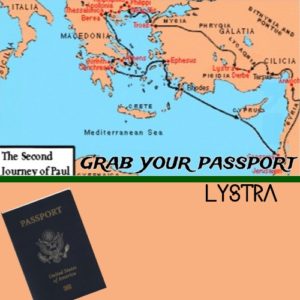
The first stop on Paul’s second journey is the village of Lystra. Our Mediterranean Moments at Lystra focus on a market village situated in a pleasant valley, bordered by gently sloping hills through which two small but steady streams meandered their way to the open Lycaonian plain a few miles farther east.  The city resided on a small hill in the middle of the valley at the intersection of the streams.  Paul evangelized the village on his first missionary journey (Acts 14:8-21); revisited it on his second (16:1) and probably his third (18:23) excursions.

History of the Village of Lystra

Little is known of the early history of Lystra.  The name is apparently from the Lycaonian language as there are several bergs with derivatives of the name in the region.  Since Lystra did not lie along the course of the main roads, it was not destined to become a great city.  As a result, it was able to preserve more of its primitive, local character when Hellenism flavored the region.


Despite these drawbacks, or perhaps because of them, Augustus designated Lystra, along with Antioch of Psidia, a Roman colony in AD 6. Roman rule demanded a safe passage way connect the two cities.  Rome ruled Lystra for some time previously, following the reign of the Seleucids and Attalids. Augustus’ generals regarded Lystra as a suitable place for the Roman garrison charged to defend the province of Galatia from the mountain tribes.


Lystra was probably not significant enough to have been on Paul’s original itinerary during the first journey.  Paul and Barnabas were driven there from Iconium by hostile opponents. Thus Lystra became a relatively unimportant city of refuge, as did Berea later when Paul and Silas fled the wrath of the Thessalonians (Acts 17:10).


Luke identifies Lystra along with Derbe as cities of Lycaonia (in contrast to Iconium).  Lycaonia was a region or “state” in a broader region known as Galatia. In turn, Galatia occupied an even broader region known as Asia Minor. References in the area become a little confusing, as “Galatia” was also the designation of a smaller “state” like Lyconia. (Compare that to our “New York City, New York” concept.)  These cities of southern Galatia were most likely the recipients of the epistle to the Galatians.

Mission and Mentoring in Mediterranean Moments at Lystra

Converts made at Lystra during the first journey fulfilled Paul’s mission. Soon, though, many allowed themselves to be carried away by efforts from Jews in the area seeking Paul’s death.  Although Lystra was a Roman colony, the account contains no hint of Roman order or justice.  At the end of his career, Paul referred to the persecution that he experienced in Lystra (2 Tim 3:11). Earlier he explicitly recalls a stoning attempt (2 Cor 11:25).  It is probable that he alluded to this life event in the Galatian letter when he poignantly proclaims that “I bear on my body the marks of Jesus” (Gal 6:17).


Mediterranean moments at Lystra remind us of the setting in which Paul started his mission and his mentoring.

Lystra

“The City of Lystra” from the lesson series Grab Your Passport, April 2021

our Scripture

Paul also came to Derbe and to Lystra.

Acts 16:1-5 ESV
Acts 16:1-5 NASB Acts 16:1-5 NIV Acts 16:1-5 NLT Acts 16:1-5 MESSAGE


Other Scriptural References:

Acts 14:6-18

2 Timothy 3:10-11

Lystra was a mildly important city in the first century, though it was somewhat of a rustic, market town. Lystra is the city’s ancient Greek name. Today it is the village called Kilistra, also called Zoldera. It was located in a relatively backward region of Lycaonia, located today in south-central Turkey. In New Testament times, it was bordered on the west by Phrygia, on the north by Galatia, toward the east by Cappadocia and by Taurus on the south. The most important city in the area, both then and now, was the city of Iconium (which is Konya today).

Lystra was founded in 26BC by Augustus to be a colony for his retired army veterans. In Paul’s day, the colony had such Italian roots they used and spoke Latin rather than Greek. Some of the Italian cults became celebrated along with those of native gods and goddesses.

Lystra is located on a road that the Apostle Paul had no doubt traveled many times, even as a youth. The path stretched from Ephesus to Sardis to Antioch of Psidia to Iconium and Lystra, to Derbe, through the Cilician Gates, to Tarsus (Paul’s hometown), to Antioch in Syria where the road divided to go east or south.

Paul’s Journeys

The second missionary journey is underway, and each of Paul’s recorded journeys is longer than the one before. His first trip was about 1580 miles long. This journey will be about 3000 miles. The final and longest journey travels about 3300 miles.


In the first journey, Paul leaves Antioch in Syria by boat, but this time he travels on foot. Traveling on foot, Paul would have first come to Tarsus then to Derbe before making his way to Lystra. Luke does not mention a synagogue in Lystra, which probably means there were less than ten Jewish families in the city. There would have been a temple to Zeus in the city, probably near the city’s gates. A statue of Hermes (Mercury) has been found in excavations there. Greek mythological stories have Hermes visiting the city.


Interestingly, on the first journey, Paul healed a lame man in the city. The people believed that the gods had come down to visit them, calling Barnabas “Zeus” and calling Paul “Hermes” because he was the chief speaker (Acts 14:8-18).

Paul Develops Leaders in Lystra

The characters traveling with Paul changes on the second journey. Barnabas has taken John Mark and chooses to set sail toward the island of Cyprus. The paths of Barnabas and Paul do not cross again in the book of Acts. Barnabas may well have either stayed on Cyprus or continued south. evidence shows a strong Christian presence and tradition in Alexandria, Egypt.

Silas

Instead Paul chooses to take Silas, who is also known as Silvanus. Silas first appears as one of the leaders in Jerusalem during the time of the council concerning the admission of Gentiles into the church (Acts 15:22). His name indicates he was a Hellenistic Jew and probably comes from a stem meaning “wood.” He appears to have been a Roman citizen (Acts 16:37). After the council in Jerusalem, Silas was one of the leaders who accompanied Paul and Barnabas to Antioch to share the letter and their encouragement (Acts 15:22-32).


He was a good choice for Paul to take on the second journey because they were first heading into the hot-bed of Judaizers through the Galatian region. Silas would have been able to verify Paul’s leadership and message to the Jews in the area. Therefore his presence may have kept the persecution and turmoil to its minimum.

Timothy

It is at Lystra that Paul adds Timothy to his companions for the journey. Paul certainly served as a mentor to both Silas and Timothy, but the relationship with Timothy appears to be even deeper. Paul speaks of their connection as that to a father and son (1 Timothy 1:2). The chances are strong that Paul helped lead Timothy to Christ on his first journey (Acts 14:6), but in the absence of any allusion to Timothy’s father in the New Testament (both his mother and grandmother are mentioned by name – 2 Timothy 1:5), Paul may have stepped into that significant role as the young man matured.


Timothy was often left behind or sent ahead on the journey to help strengthen new believers or pave the way for the coming evangelistic message. Tradition has Timothy playing a significant role at the church in Ephesus. Timothy became one of Paul’s constant companions up until the point of the Apostle’s death.


Lesson Series This Lesson: The Pointe This Lesson: Mediterranean Moments
KBS_2105_Grab_Your_Passport
Mediterranean Moments

Antioch was the first major city outside of Jerusalem in Judea to become a center for the activities of the Jewish believers who followed Christ. From the outset, these believers seemed to follow a different path than the other Jews. Friedrich Nietzsche, the German philosopher and scholar, responded once, “The essential thing in heaven and earth is … that there should be a long obedience in the same direction.”  The way of the Christian is unique.

The Way

Jesus offers His words of farewell to His disciples in the closing moments of the gathering in the upper room. John records some of the words in the fourteenth chapter of his gospel. In the physical turmoil of life and the spiritual chaos inside the heart, Jesus tells the disciples to stop the “trouble” – the commotion. “Let not your hearts be troubled” (John 14:1 ESV). The Greek word for troubled (ταρασσέσθω, TARASESTHO) denotes a heavy sea in the midst of the wind and storm.

Troubles Along the Way

This “Moment” article began being written on April 15, 2021. The day began with a shooting in Chicago resulting in 4 people injured in Humboldt Park. Later five people were shot outside an apartment complex in Pensacola, Florida. Police say that four different shooters were involved. Soon three men and a teen-aged girl were wounded on the northern side of Washington, D.C. The stunning incident of the day was a shooting outside a FedEx facility in Indianapolis, Indiana. Nine people are dead and another 7 injured. Among the dead was the shooter, a 19-year-old former FedEx employee.

The article was finished and posted in the afternoon on April 18, 2021. At 3:00pm, Kenosha, Wisconsin saw three people killed and two others injured after a shooting at a tavern. Another shooting was in progress in Austin, Texas, where three were dead and reports of injuries were beginning to trickle across the newswires.

In between the days, four people were shot at a vigil on the East Side of Detroit on April 16th. Columbus, Oh saw a woman killed and five others injured at a vigil for another homicide victim on April 17th.

The entire area is “troubled.” Things aren’t as they should be. Our culture reels from the trouble, pain and uncertainty.

In the hurricane that is life, or when the hurricanes hit life, I can’t find the way. There is too much wind. There is too much rain. I can’t see the way. I am not even sure there is a way.

Jesus said, “I am the way.”

A Better Way

The history of the faithful is a story of roads. The first followers of Jesus called themselves “the Way.” The name had Jewish roots as the name echoed the “way of life” that was threaded into the Torah. It spoke to the Christians’ belief that Jesus was “the way” to God the Father.

Throughout the history of the religions of people, religious icons claim to be signposts pointing the way. The goals of human existence. The path to the next life. Except Christianity.

As John Stott says in his classic Basic Christianity, “Jesus was not just another signpost, but the destination to which the signposts had led.” Jesus claimed to be the Way Himself.

The early believers seemed so like Him they became known as the Way. From Jerusalem to Damascus, Christians are known as the Way.

But Saul, still breathing threats and murder against the disciples of the Lord, went to the high priest and asked him for letters to the synagogues at Damascus, so that if he found any belonging to the Way, men or women, he might bring them bound to Jerusalem Acts 9:1-2 ESV).

And the name was known at least as far away as Ephesus.

But when some became stubborn and continued in unbelief, speaking evil of the Way before the congregation, he withdrew from them and took the disciples with him, reasoning daily in the hall of Tyrannus (Acts 19:9 ESV).


Christians

“A rose by any other name would smell as sweet.” The actual origin of the phrase is unknown, but it is said to be coined by William Shakespeare. Juliet says the phrase in reference to family and particularly the family name of Romeo.

The truth is the creation of a new name is important. A name is embedded into a context – a context drawing from experiences and circumstances that help define a new reality.

The early church were known as followers of the Way, often shortened to just “The Way.” It wasn’t a name claimed by their own; it was a name bestowed upon them by others.  These followers of Christ were first called “Christians” by the leaders of the community in Antioch (Acts 11:26).

The interesting – and quite unusual – thing about this is that sects of the Jewish faith usually did not get a distinctive name among the Gentile population. The Jewish faith had Pharisees and Sadducees and Essenes but to the outside world they were all Jews. So why weren’t Christians simply lumped in with all the other variants of the Jewish faith?

More Than Just Another Sect

A little context to the culture might help. The city of Antioch was often referred to as “all the world in one city.” You could see the riches and diversity of the entire world located in one city. Antioch was designed like most cities of the day – a circular wall surrounding the boundaries of the city and inner marketplace at the center of the city, serving as its hub. From the hub of the city were inner walls, sometimes constructed, sometimes natural barriers that served as spokes reaching from the hub to the outer wall. The spokes marked ways that divided different people groups from one another. Jews from Gentiles. Rich from poor. Color from color.

Until the Christians came here. Christians could be found in every spoke of the city’s wheel. The image of Christians in Antioch was not just that they were united, but they united others, breaking down the barriers, seeing life existing through, and in spite, of differences.

And remember Antioch was one of the first cities outside Judea where Christianity spread.

Breaking Down the Walls

The term “Christian” comes from the world realizing that something new and unheard of was happening. Remember what Paul used to write? In Christ there was no male nor female, no Jew nor Greek.

After Acts 11:26 the word “Christian” is only found two other times in the New Testament. King Agrippa used the word in Acts 26:28 – an unbelieving king applied the name that he knew as an outsider. The apostle Paul uses the word the only other time in 1 Peter 4:16 to speak of being oppressed in a wider society because of the label of that name.

I wonder if he used it because of how aware Peter was that the spokes of the city needed to be gone. For a while Peter struggled because he was afraid of unity when he was around some conservative Jewish brothers (Galatians 2:11-17). God nudged him once before in a dream (Acts 10). This time Paul scolded him publiclly to his face (Acts 15).

Christians defied categories. They lived like they didn’t exist. Are we able to show the world a vision of a community in which there is no social, economic, racial or gender divisions (Galatians 3:28; Colossians 3:10-11)?

Billy Graham’s website carries an article written by Graham about ten years ago. He begins the lesson by asking, “Have you ever thought about what the word ‘Christian’ means? It comes from a Latin word. It means ‘partisan for Christ.’ When you come to Christ, you take sides. You take sides with Christ.

Partisans are never neutral. They never play it safe. They never sit on the fence. They’re never spectators of the struggle of their times. They commit themselves.”

Is it any wonder that on the first psalm sung in the ascent to Jerusalem, the psalmist chants:

Deliver me, O Lord

from lying lips, from a deceitful tongue.

Woe to me, that I sojourn in Meshech,

that I dwell among the tents of Kedar!

Too long have I had my dwelling

among those who hate peace (Psalm 120:2, 5-6 ESV).

The Series This Lesson: Antioch This Lesson: The Pointe
KBS_2105_Grab_Your_Passport grab your passport: antioch