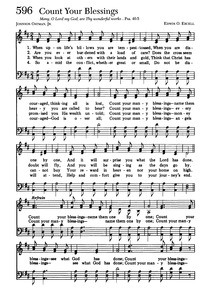
Count Your Blessings

Gipsy Smith, a famous evangelist in Great Britain of yesteryear, said of the blessings in this song, “Men sing it, boys whistle it and women rock their babies to sleep to it.”

Johnson Oatman, Jr., born April 21, 1856, was a citizen of Lumberton, N.J. His dad was a local merchant and just happened to be the best singer in town, with a rich, powerful voice. Young Johnson could not sing as well as his father and his father told everyone, “Don’t let Johnson sing.” The truth was the elder Oatman wanted his son to become a pastor in the Methodist church. The family sent young Johnson to finishing school and to seminary. Eventually Johnson was ordained in the Methodist Episcopal churches. The boy was uneasy and troubled, for he wanted to make some kind of contribution with music, just like his father.

Likewise, I can relate to wanting to please my father, can you? To this day I can remember as a seven-year old hearing my father tell his friends, “The boy couldn’t carry a tune in a number 10 washtub.” Our cherub choir had performed a couple of songs for the Sunday evening church worship service. I spent the rest of my life trying to prove my father wrong.

Johnson felt the same way.

Happy hymns

At 36, he realized that he did, without question, have a musical talent after all. He was able to write songs for other Christians to sing. Johnson had as his goal the challenge of writing a hymn every day. Eventually he had written 5,000 songs and was happy that in his musical compositions he had found a way to “preach the Gospel.”

Of all the songs Oatman wrote, Johnson seemed to claim as his own favorites, “No, Not One” and “Higher Ground.”

One of the last songs that he wrote, this particular hymn reflected his tedious process of making sure that each year he had written enough hymns. Oatman died in Norman, OK in 1922.

Perhaps you have guessed the famous and popular hymn written by Johnson Oatman, Count Your Blessings. Thinking about its words seems incredibly important at this time of year.

When upon life’s billows you are tempest tossed,
When you are discouraged, thinking all is lost,
Count your many blessings, name them one by one,
And it will surprise you what the Lord hath done.

Refrain

Count your blessings, name them one by one,

Count your blessings, see what God hath done!

Count your blessings, name them one by one,

And it will surprise you what the Lord hath done.

Tempest tossed

Do you know what a tempest is? A tempest is a storm at sea. Have you ever been caught in a storm at sea? Ocean, sea or water of any kind rarely invites my presence. But this past year, performing the marriage ceremony for my sister beckoned my service. Her marriage dreams included the exchanging of vows on the edge of the beach at Panama City. The wedding was to take place at 5:30 in the afternoon, about three hours after Hurricane Irma was to bombard the beach. We moved the time table forward, and the hour ceremony was given a “Reader’s Digest” touch in just a half-an-hour, and literally just steps ahead of the storm.

An older gentleman spectator said we should count our blessings that we averted the hurricane.

The wonderful encouragement to “Count your blessings” is often misused. Counting blessings does not mean you deny that you’re having problems. It does not mean to ignore your troubling emotions. The advice to “Cheer up and act like everything is fine” just doesn’t work! Turning a blind eye to the problem certainly doesn’t lead to lasting joy and peace. The hymn is actually encouraging us to acknowledge openly that we are “tempest-tossed.”

Angry waves, or God’s calm?

What is your tempest? Can you see it coming across the sea’s horizon? Have you determined to face it alone – or would it be smarter to “batten down the hatches” by bathing the circumstance in prayer?

Therefore, whatever your tempest, look at it closely. The smudges of God’s fingerprints  illuminate in front of the prayerful eye. His hand grasped it tightly from the very beginning.

In God’s hands, your tempest counts as a blessing. Go figure .

Counting your blessings appreciates, one-by-one, moment-by-moment, God’s involvement in daily life, “working all things together for good.” It understands that we have “every spiritual blessing in Christ” (Ephesians 1:3). Genuine thanks and praise to God goes with openly unburdening ourselves before the listening ears of the “Father of compassion” and “God of all comfort,” (2 Corinthians 1:3-4).

Today, count your blessings. Name them, one by one. It just may surprise you what the Lord has done.
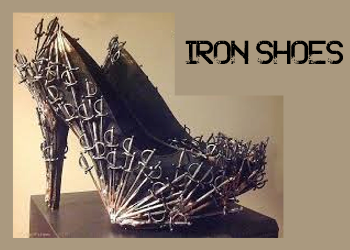
Newspaper articles: Iron Shoes, rough, long, lonely, home

What do we do when the road is lonely?

Sometimes we need shoes made of iron.

We learned a very simple truth a few weeks ago.

God prepares us for a task by providing us with the right kind of shoes.

We concentrated on one verse of Scripture, Deuteronomy 33:25, Your sandals shall be iron and bronze; As your days, so shall your strength be. We have discussed what that passage might mean. We have asked questions for when the road gets rough, or when the road seems long. What if the road is lonely?

A. W. Tozer (1897 – 1963) was an American pastor, author, magazine editor and mentor. Tozer spent his last years of ministry in the province of Ontario, Canada. Buried in Akron, Ohio, he grave is marked with a simple epitaph: A.W.Tozer – A Man of God. In one of his books, he wrote,

Most of the world’s great souls have been lonely. Loneliness seems to be one price the saint must pay for his saintliness. In the morning of the world (or should we say, in that strange darkness that came soon after the dawn of man’s creation) that pious soul, Enoch, walked with God and was not, for God took him; and while it is not stated in so many words, a fair inference is that Enoch walked a path quite apart from his contemporaries.

Another lonely man was Noah who, of all the antediluvians, found grace in the sight of God; and every shred of evidence points to the aloneness of his life even while surrounded by his people.

Jesus said, “16 You will be betrayed even by parents, brothers and sisters, relatives and friends, and they will put some of you to death. 17 Everyone will hate you because of me” (Luke 21:16-17 NIV).

WHY IS THE ROAD SO LONELY?

The road for the believer is many times a lonely one. The road that follows Jesus’ endurance to the cross is one that is seldom busy. It can be a rough, long path. It can be a path that few choose to follow. And we so often want a path that is easy.

Last week made me feel lonely. The day was January 22, 2018. Eighteen people were wounded at Marshall County High School, just about 20 miles from the site of an earlier school tragedy in Paducah, Kentucky. A girl was pronounced dead at the scene. Another boy died at the hospital. The suspect was taken into custody by local officials. All were only fifteen.

Loneliness seems to be one price the saint must pay for his saintliness.

According to the Washington Enquirer, the shooting was the 10th incident of gunshots fired on the grounds of US schools in 2018. The next day newscasts focused on the ad nauseum investigations of a possible collusion with the Russians by President Trump, the horrific trial of ex-gymnastics doctor Larry Nassar, and marches for women’s rights across the country. Have we really become so callused toward shootings that it doesn’t bother us anymore? Doesn’t anyone understand this isn’t an issue of too many guns, but of too little faith? Am I the only one that sees this connection?

In spite of the noise of the road, I feel surprisingly alone. The voice of God is not found in the riddling of bullets, the cries of the marching crowds, or the screams of the wounded and appalled victims.

Like Elijah, we hear the voice in a whisper. You are not alone. Others have not bowed their knees. I am still here.

13 “Enter through the narrow gate. For wide is the gate and broad is the road that leads to destruction, and many enter through it. 14 But small is the gate and narrow the road that leads to life, and only a few find it” (Matthew 7:13-14 NIV). Even though few choose to walk this path, you are not alone.

WHY IS LONELINESS SO DIFFICULT?

It is a challenge to feel lonely. Loneliness is difficult because we are tempted fiercely by the devil during these troubling times. But remember the biblical truth: Satan is a liar. Here are some of the lies:

1) Loneliness means I am alone. Satan’s huge lie to us is that we walk by ourselves, that no one chooses to walk with us.

2) No one understands. One reason temptation arises is because we don’t know many people who endure the same circumstances and burdens that we are carrying. If the enemy can make us believe that there really is no one who understands, it will tempt us to shut out others even more.

3) A loving God wouldn’t let me take such a road. That same loving God walked with His own Son down the loneliest road ever known to man. 4) I must not have enough faith. Loneliness is not hopelessness. It does not lead to defeat. It is not an indication of a lack of faith. Although we may feel alone, we are never really abandoned.

Jesus wondered if his disciples, both then and now, understood his message. 32 “A time is coming and in fact has come when you will be scattered, each to your own home. You will leave me all alone. Yet I am not alone, for my Father is with me. 33 “I have told you these things, so that in me you may have peace” (John 16:31-33 NIV).

You can find peace. Remember, you have shoes fitted for your feet that are up for the task. Even if the road seems lonely.

Newspaper articles: Iron Shoes, rough, long, lonely, home

Do you make resolutions for the new year? If you do, you are certainly not alone. According to Forbes magazine as many as 45% of Americans make promises of change for the coming year. For perspective, the Super Bowl, the most watched television event – the one that drives commercials and spending in unimaginable ways – draws only about a third of all Americans. While resolutions are on our minds, they aren’t always in our hearts. This year, instead of thinking about resolutions, let’s think about how God prepares us for this year’s journey by fitting us with right kind of shoes – sometimes even iron shoes.

What are the most relentlessly promised resolutions? According to the Journal of Clinical Psychology published by the University of Scranton, the top ten resolutions, in order, are losing weight, getting organized, spending less and saving more money, enjoying life to the fullest, staying fit and healthy, learning something new and exciting, quitting smoking, helping others achieve their dreams, falling in love and spending more time with the family.

But for all our good intentions, the same study reveals that only about 8% actually keep the resolution for more than six months. Why do so many fail at goal-setting and keeping? More importantly – are there keys for success shared by the 8%?

I have resolved that this year I will make no resolutions. Let me tell you a story that got me thinking.

Not too long ago, I needed to buy a new pair of tennis shoes.

I went down to the shoe store and told the clerk I needed tennis shoes. He said, “What kind of tennis shoes do you need?” He was right. There were all kinds of tennis shoes. There were tennis shoes for baseball, cross country, track, basketball, biking and working out. There were even tennis shoes for tennis. I had to know what kind of tennis shoes I needed.

What kind of shoes are you wearing? It kind of depends on what you are planning to do, doesn’t it? The matter of shoes is important. Our shoes help prepare us for the task.

God prepares us for a task by providing us with the right kind of shoes.

We are going to start the year by remembering a very simple lesson. God prepares us for a task by providing us with the right kind of shoes. Would you believe that there are times that He provides us with iron shoes?

There is an obscure passage of Scripture in the Old Testament book of Deuteronomy that deserves our attention for the next few weeks. It is a verse that is not easily translated. The passage of Scripture is Deuteronomy 33:25. The New International Version translates it this way:

The bolts of your gates will be iron and bronze, and your strength will equal your days.

Many of the translations of the Bible give it a similar flavor. But look at how the New King James Version translates the verse. “Your sandals shall be iron and bronze; As your days, so shall your strength be.”

The truth is either translation is appropriate. The question is, in context which makes the most sense? The Hebrew language is made up of only consonants. The vowels come from the context and traditions of the oral language. Just like the English consonants “R” and “D” could produce “red” or “read” – two very different concepts, the same is true in the Hebrew language.

Oswald Chambers, author of several devotional books including “My Utmost for His Highest,” writes, “Every path that leads to heaven is trodden by willing feet. No one is ever driven to paradise. The real test of a saint is not one’s willingness to preach the gospel, but one’s willingness to do something like washing feet – that is, being willing to do those things which seem unimportant but count as everything do God.”

As I look into 2018, I wonder what has God prepared my feet to do. I am reminded of three lessons.

First, God is always strengthening my feet. One of my favorite verses of scripture is a small verse in a small book from a minor prophet, Habakkuk. “The Sovereign Lord is my strength; he makes my feet like the feet of a deer, he enables me to tread on the heights” (Habakkuk 3:19 NIV). The concept of God making our feet like the feet of a deer is common in the Old Testament (2 Samuel 22:32-35; Psalm 18:33-36, Psalm 121:2-5, etc.).

God makes our feet like the feet of a hind. A hind is a red female deer and is the most sure-footed mountain animal in all of God’s creation. Hind’s feet are skinny, and as such can move effortlessly through rough and steep mountainous terrain without stumbling. God equips us to overcome adversity and difficult roadblocks. Though the situation may seem rocky, the Lord will equip you so that you don’t stumble and that you press on your journey with consistency.

Second, my greatest task is to share the story of the Gospel with my own words. Interestingly, when we are told that our feet become like deer in the mountains, and that God will not let our foot slip – and that He watches over us night and day, we are told also How beautiful on the mountains are the feet of those who bring good news, who proclaim peace, who bring good tidings, who proclaim salvation, who say to Zion, “Your God reigns” (Isaiah 52:7)!

Finally, God provides you with shoes for battle, sometimes even iron shoes. Your job includes doing battle with the devil. Paul says it like this, Stand firm then, with the belt of truth buckled around your waist, with the breastplate of righteousness in place, and with your feet fitted with the readiness that comes from the gospel of peace. In addition to all this, take up the shield of faith, with which you can extinguish all the flaming arrows of the evil one (Ephesians 6:14-16 NIV).

No need for resolutions for this year. Look at how God is preparing your feet. But never forget: sometimes we need iron shoes.