the Pointe

People from many walks of life speak of the POV. Point Of View as listed at dictionary.com contains three similar meanings:

  • a specified or stated manner of consideration or appraisal; standpoint
  • an opinion, attitude or judgment
  • the position of the narrator in relation to the story, as indicated by the narrator’s outlook from which the events are depicted and by the attitude toward the characters

Videos or movies are often given a particular POV. The story may even be told from the POV of the viewer or reader.

Luke’s Point of View

Luke writes the history of the early church through the activities of the apostles Peter and Paul. During Paul’s second missionary journey, Luke joins Paul’s group in their travels. The account of the history has the flavor or POV of someone who experienced the mission. Luke provides his POV on the group’s time spent in Berea.

The historian analyzes the Berean Jews, likely comparing them to the Jews they had met in Philippi and Thessalonica. Luke summarizes that these Jews were of a different nature. He describes them with the Greek word εὐγενέστερος (EU-GEN-ESTER-OS) literally meaning “well-bred.” Originally it meant someone who came from a wealthy and well-educated family, but over the years it developed the connotation of someone who was open-minded, tolerant, generous, and kind-hearted. The character and integrity of the people to whom Paul spoke impressed the author of Acts.

Understanding the Pointe in Berea

He continues on to explain why their nature struck him so strongly. “They examined the Scriptures every day to see if what Paul said was true” (Acts 17:11). They did not take the easy route of either extreme – accepting everything Paul said, or immediately rejecting his words out of anger. Instead they weighed carefully his message against the message of Scripture.

As we look to the pointe in Berea, Luke’s perspectives helps place things in focus.

  1. We should strive to receive the message of Scripture with eagerness. There should be an excited anticipation any time we will have God’s Word shared with us.
  2. When we hear a message from Scripture, we need to examine the message and compare it to Scripture to collaborate its truth. Although we develop a trusting relationship with many of our teachers and mentors, we need to constantly balance our trust with critical (not negative) evaluation. Does the message, lesson or sermon mesh with the teachings of Scripture?
  3. We should spend time in the Scriptures daily. Our understanding of Scripture cannot mature by seeing it once a week and having someone else feed it to us. The responsibility become entrenched in the Word rests on our shoulders. Time each day on our own will deepen our understanding.


Lesson Series This Lesson Mediterranean Moments
KBS_2105_Grab_Your_Passport Mediterranean Moments
Mediterranean Moments

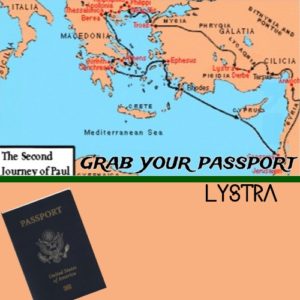
The first stop on Paul’s second journey is the village of Lystra. Our Mediterranean Moments at Lystra focus on a market village situated in a pleasant valley, bordered by gently sloping hills through which two small but steady streams meandered their way to the open Lycaonian plain a few miles farther east.  The city resided on a small hill in the middle of the valley at the intersection of the streams.  Paul evangelized the village on his first missionary journey (Acts 14:8-21); revisited it on his second (16:1) and probably his third (18:23) excursions.

History of the Village of Lystra

Little is known of the early history of Lystra.  The name is apparently from the Lycaonian language as there are several bergs with derivatives of the name in the region.  Since Lystra did not lie along the course of the main roads, it was not destined to become a great city.  As a result, it was able to preserve more of its primitive, local character when Hellenism flavored the region.


Despite these drawbacks, or perhaps because of them, Augustus designated Lystra, along with Antioch of Psidia, a Roman colony in AD 6. Roman rule demanded a safe passage way connect the two cities.  Rome ruled Lystra for some time previously, following the reign of the Seleucids and Attalids. Augustus’ generals regarded Lystra as a suitable place for the Roman garrison charged to defend the province of Galatia from the mountain tribes.


Lystra was probably not significant enough to have been on Paul’s original itinerary during the first journey.  Paul and Barnabas were driven there from Iconium by hostile opponents. Thus Lystra became a relatively unimportant city of refuge, as did Berea later when Paul and Silas fled the wrath of the Thessalonians (Acts 17:10).


Luke identifies Lystra along with Derbe as cities of Lycaonia (in contrast to Iconium).  Lycaonia was a region or “state” in a broader region known as Galatia. In turn, Galatia occupied an even broader region known as Asia Minor. References in the area become a little confusing, as “Galatia” was also the designation of a smaller “state” like Lyconia. (Compare that to our “New York City, New York” concept.)  These cities of southern Galatia were most likely the recipients of the epistle to the Galatians.

Mission and Mentoring in Mediterranean Moments at Lystra

Converts made at Lystra during the first journey fulfilled Paul’s mission. Soon, though, many allowed themselves to be carried away by efforts from Jews in the area seeking Paul’s death.  Although Lystra was a Roman colony, the account contains no hint of Roman order or justice.  At the end of his career, Paul referred to the persecution that he experienced in Lystra (2 Tim 3:11). Earlier he explicitly recalls a stoning attempt (2 Cor 11:25).  It is probable that he alluded to this life event in the Galatian letter when he poignantly proclaims that “I bear on my body the marks of Jesus” (Gal 6:17).


Mediterranean moments at Lystra remind us of the setting in which Paul started his mission and his mentoring.

Lystra

“The City of Lystra” from the lesson series Grab Your Passport, April 2021

our Scripture

Paul also came to Derbe and to Lystra.

Acts 16:1-5 ESV
Acts 16:1-5 NASB Acts 16:1-5 NIV Acts 16:1-5 NLT Acts 16:1-5 MESSAGE


Other Scriptural References:

Acts 14:6-18

2 Timothy 3:10-11

Lystra was a mildly important city in the first century, though it was somewhat of a rustic, market town. Lystra is the city’s ancient Greek name. Today it is the village called Kilistra, also called Zoldera. It was located in a relatively backward region of Lycaonia, located today in south-central Turkey. In New Testament times, it was bordered on the west by Phrygia, on the north by Galatia, toward the east by Cappadocia and by Taurus on the south. The most important city in the area, both then and now, was the city of Iconium (which is Konya today).

Lystra was founded in 26BC by Augustus to be a colony for his retired army veterans. In Paul’s day, the colony had such Italian roots they used and spoke Latin rather than Greek. Some of the Italian cults became celebrated along with those of native gods and goddesses.

Lystra is located on a road that the Apostle Paul had no doubt traveled many times, even as a youth. The path stretched from Ephesus to Sardis to Antioch of Psidia to Iconium and Lystra, to Derbe, through the Cilician Gates, to Tarsus (Paul’s hometown), to Antioch in Syria where the road divided to go east or south.

Paul’s Journeys

The second missionary journey is underway, and each of Paul’s recorded journeys is longer than the one before. His first trip was about 1580 miles long. This journey will be about 3000 miles. The final and longest journey travels about 3300 miles.


In the first journey, Paul leaves Antioch in Syria by boat, but this time he travels on foot. Traveling on foot, Paul would have first come to Tarsus then to Derbe before making his way to Lystra. Luke does not mention a synagogue in Lystra, which probably means there were less than ten Jewish families in the city. There would have been a temple to Zeus in the city, probably near the city’s gates. A statue of Hermes (Mercury) has been found in excavations there. Greek mythological stories have Hermes visiting the city.


Interestingly, on the first journey, Paul healed a lame man in the city. The people believed that the gods had come down to visit them, calling Barnabas “Zeus” and calling Paul “Hermes” because he was the chief speaker (Acts 14:8-18).

Paul Develops Leaders in Lystra

The characters traveling with Paul changes on the second journey. Barnabas has taken John Mark and chooses to set sail toward the island of Cyprus. The paths of Barnabas and Paul do not cross again in the book of Acts. Barnabas may well have either stayed on Cyprus or continued south. evidence shows a strong Christian presence and tradition in Alexandria, Egypt.

Silas

Instead Paul chooses to take Silas, who is also known as Silvanus. Silas first appears as one of the leaders in Jerusalem during the time of the council concerning the admission of Gentiles into the church (Acts 15:22). His name indicates he was a Hellenistic Jew and probably comes from a stem meaning “wood.” He appears to have been a Roman citizen (Acts 16:37). After the council in Jerusalem, Silas was one of the leaders who accompanied Paul and Barnabas to Antioch to share the letter and their encouragement (Acts 15:22-32).


He was a good choice for Paul to take on the second journey because they were first heading into the hot-bed of Judaizers through the Galatian region. Silas would have been able to verify Paul’s leadership and message to the Jews in the area. Therefore his presence may have kept the persecution and turmoil to its minimum.

Timothy

It is at Lystra that Paul adds Timothy to his companions for the journey. Paul certainly served as a mentor to both Silas and Timothy, but the relationship with Timothy appears to be even deeper. Paul speaks of their connection as that to a father and son (1 Timothy 1:2). The chances are strong that Paul helped lead Timothy to Christ on his first journey (Acts 14:6), but in the absence of any allusion to Timothy’s father in the New Testament (both his mother and grandmother are mentioned by name – 2 Timothy 1:5), Paul may have stepped into that significant role as the young man matured.


Timothy was often left behind or sent ahead on the journey to help strengthen new believers or pave the way for the coming evangelistic message. Tradition has Timothy playing a significant role at the church in Ephesus. Timothy became one of Paul’s constant companions up until the point of the Apostle’s death.


Lesson Series This Lesson: The Pointe This Lesson: Mediterranean Moments
KBS_2105_Grab_Your_Passport